
Written by the Stay Wandery Editorial Team | Luxury Vacation Rental Properties, Sedona, Arizona | Updated August 2026
Research Transparency: This guide is based on our experience as the team behind Stay Wandery in Sedona. Throughout the year, we help guests plan their trips by explaining what each trail, canyon, and season actually requires, from parking passes and shuttle rules to crowd levels and drive times. The recommendations here combine our firsthand local insight with thorough research to help you plan a Sedona trip that actually works.
Disclosure: Stay Wandery properties are our own vacation rentals, so they’re featured because we know them best through daily operations and guest feedback. We also encourage you to explore the other accommodations and businesses mentioned throughout this guide to find what best matches your travel plans. Prices, hours, and trail conditions reflect the latest data available as of August 2026; though these details change often, we review and update this guide regularly to keep it accurate.
The Complete Sedona Travel Guide (2026)
Sedona, Arizona, travel guide planning trips up more first-time guests than any single trail or attraction we get asked about.
Every week, someone calls us convinced they can drive straight to Devil’s Bridge and park at the trailhead, only to learn the lot has been closed for a shuttle since 2022.
We manage five luxury rental properties here, and the questions we field aren’t really about which red rock formation looks best in photos.
They’re about logistics: when to come, where the shuttle actually runs, whether a Red Rock Pass covers Slide Rock State Park (it doesn’t), and how many days a Sedona trip genuinely needs.
This guide answers those questions with current numbers, not guesses, and folds in the corrections we make with guests on nearly every pre-arrival call.
First-Time Guide to Sedona: What Visitors Get Wrong About Sedona, Arizona Travel
A few corrections we make constantly, before you even start planning:
- Sedona is not one neighborhood. Uptown Sedona, West Sedona, and the Village of Oak Creek each have a different feel, different parking situations, and different drive times to trailheads.
- Hiking itself is free everywhere in Coconino National Forest. What costs money is parking, and the fee structure is genuinely confusing (we break it down below).
- The elevation surprises people. Sedona sits at roughly 4,500 feet, so it’s noticeably cooler than Phoenix year-round; summer highs run in the high 80s to mid-90s°F rather than Phoenix’s regular 105°F-plus days.
- The shuttle isn’t optional. Many of Sedona’s most photographed trailheads close their parking lots on certain days and require a free shuttle instead. Showing up without knowing the schedule is the single most common planning mistake we see.
What We Tell Our Guests: The question we get asked most during check-in calls is some version of “can we just drive to the trailhead?”
For Cathedral Rock and a few others, the honest answer is often no. From Thursday through Sunday, year-round, the parking lots at Cathedral Rock and Little Horse close, and access is only by the free Sedona Shuttle from the North SR-179 Park and Ride.
Check the current Sedona Shuttle schedule the morning of your hike; wildfire activity or maintenance can shift routes with little notice.
Getting to Sedona: What is the Closest Airport to Sedona?
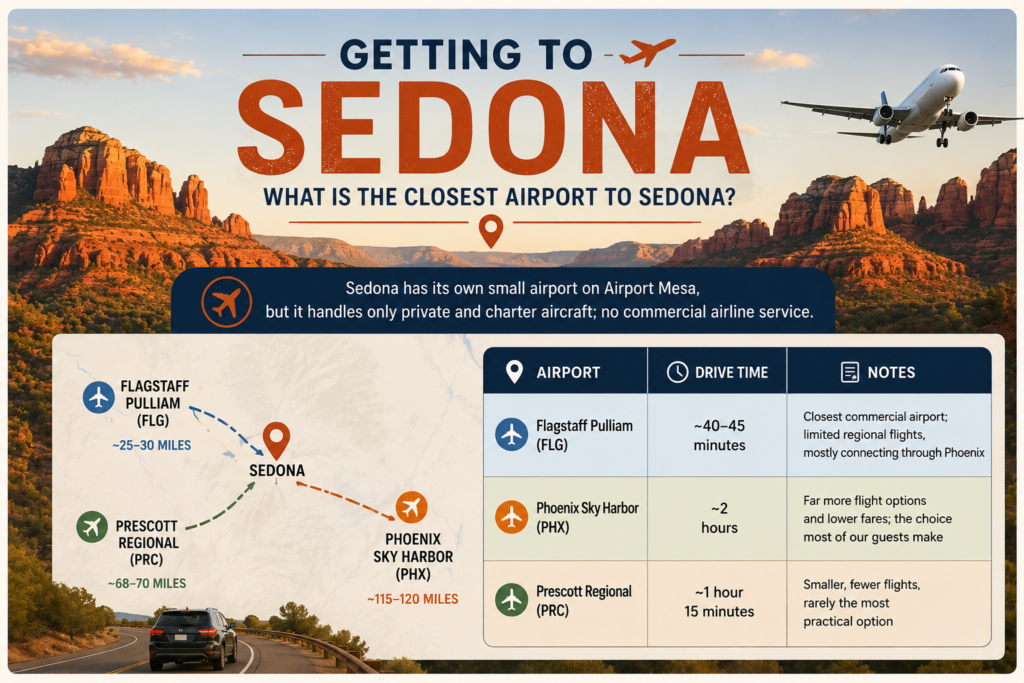
Sedona has its own small airport on Airport Mesa, but it handles only private and charter aircraft; no commercial airline service.
| Airport | Distance from Sedona | Drive Time | Notes |
| Flagstaff Pulliam (FLG) | ~25–30 miles | ~40–45 minutes | Closest commercial airport; limited regional flights, mostly connecting through Phoenix |
| Phoenix Sky Harbor (PHX) | ~115–120 miles | ~2 hours | Far more flight options and lower fares; the choice most of our guests make |
| Prescott Regional (PRC) | ~68–70 miles | ~1 hour 15 minutes | Smaller, fewer flights, rarely the most practical option |
For most travelers, we recommend flying into Phoenix Sky Harbor.
The extra driving time is generally offset by significantly more flight options and lower average fares, and the drive itself, up I-17 and onto Highway 179, is scenic enough to ease you into the red rock landscape gradually.
Getting Around: Essential Sedona Tourism & Transit Tips
Once you’re here, a rental car is close to essential. Sedona’s public transit is limited to the trailhead shuttle system, not general-purpose transportation, so plan on driving between neighborhoods and trailheads.
- Two main roads carry almost all traffic: State Route 89A (running through Uptown and West Sedona, and up into Oak Creek Canyon toward Flagstaff) and State Route 179 (running toward the Village of Oak Creek and I-17).
- Both can back up badly during peak season and around sunset, when everyone is converging on the same overlooks at once.
- Roundabouts, not traffic lights, control most intersections along 179; they’re efficient once you’re used to them, but budget a few extra minutes if you’re unfamiliar.
- High-clearance or 4×4 vehicles open up backroads like Schnebly Hill Road and give you closer access to a couple of trailheads (like Devil’s Bridge itself), but they are not required for the vast majority of the itinerary in this guide.
- Cell service is patchy in the canyons and on backcountry roads. Download offline maps before you head out for the day.
Where to Stay in Sedona for Your Upcoming Trip
Choosing a base matters more in Sedona than in a lot of destinations, because the town spreads across a few distinct areas with different drive times to the trails.
| Area | Feel | Best For | Typical Drive to Popular Trailheads |
| Uptown Sedona | Walkable, shops and restaurants, busiest | First-timers who want to walk to dinner | 10–20 minutes to most trailheads |
| West Sedona | Quieter, more local, closer to Dry Creek trailheads | Guests prioritizing hiking access | 5–15 minutes to the Devil’s Bridge area |
| Village of Oak Creek | South of town, closer to Bell Rock and Cathedral Rock | Guests focused on southern trailheads | 5–10 minutes to Bell Rock and Cathedral Rock |
Worth the Extra Drive: Guests occasionally ask whether staying farther from Uptown to be closer to Devil’s Bridge is worth it. In our experience, no.
Sedona is small enough that even our Uptown-area properties put you within a 10–20 minute drive of nearly every major trailhead, and you gain a walkable evening in exchange.
We’d rather see guests drive an extra ten minutes to a trailhead in the morning than lose the ability to walk to dinner at night.
Stay Wandery Sedona: Luxury Vacation Rentals for Sedona Vacation Planning
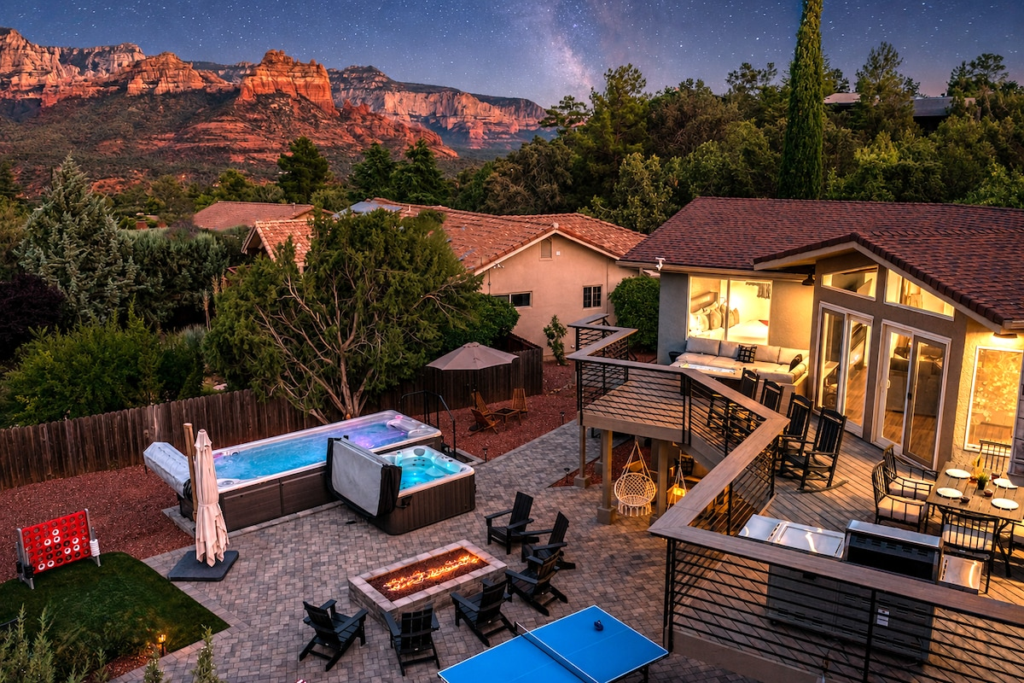
Whether you are traveling with a large group or seeking a private desert escape, Stay Wandery offers premier, fully equipped luxury vacation rentals placed right near Sedona’s top attractions and trailheads.
| Property | Sleeps | Bed/Bath | Highlights | From (per night, 3-night min.) | Best For |
| Uptown EPIC! | Up to 25 | 10 bed / 8.5 bath | Two connected houses, two 20-ft heated pools & spas, two full kitchens, two game rooms, putting green, fire pits, walking distance to Uptown | ~$2,242 | Large multi-family reunions or wedding parties |
| Uptown Sparks! | Up to 13 | 5 bed / 4.5 bath | 20-ft heated pool & hot tub, Red Rock-facing deck, fire table, fenced yard, putting & yoga space, walkable to Uptown | ~$460 | Larger friend groups wanting an Uptown location |
| Starview Sedona! | Up to 12 | 4 bed / 3 bath | 30×15-ft heated pool, 8-person hot tub, arcade room, pool table, ping pong, near Tlaquepaque | ~$560 | Guests planning a Tlaquepaque afternoon on foot |
| SkyLine Sedona! | Up to 12 | 5 bed / 4 bath | King bed in every room, 30×15-ft heated pool & hot tub, two firepits, hammocks, arcade room, wall-to-wall Red Rock views | ~$598 | Couples’ groups who each want their own king room |
| Uptown Splash! | Up to 12 | 5 bed / 4 bath | 20-ft heated pool & hot tub or swim spa, large deck, putting green, fire pit, separate studio suite | ~$460 | Groups needing a private studio for grandparents or an au pair |
All five properties require a 3-night minimum stay and include a heated pool and spa setup, which our guests use constantly after hiking days; Sedona’s evenings cool down quickly even in summer.
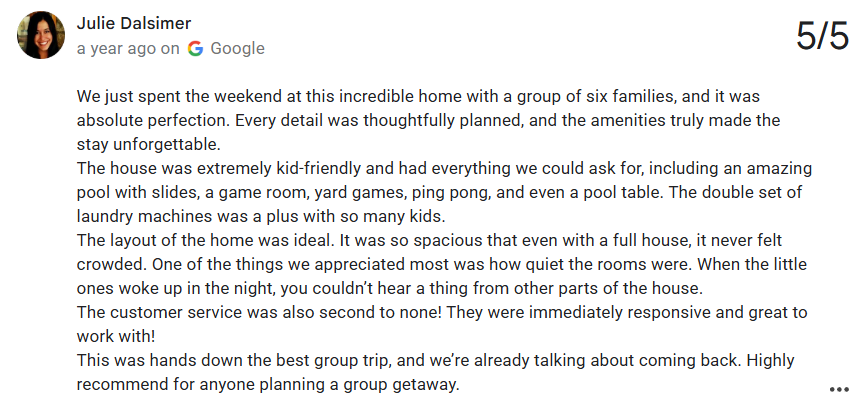
Our properties also hold a 4.4-star rating on Google, reflecting the experience guests have had during their stays.
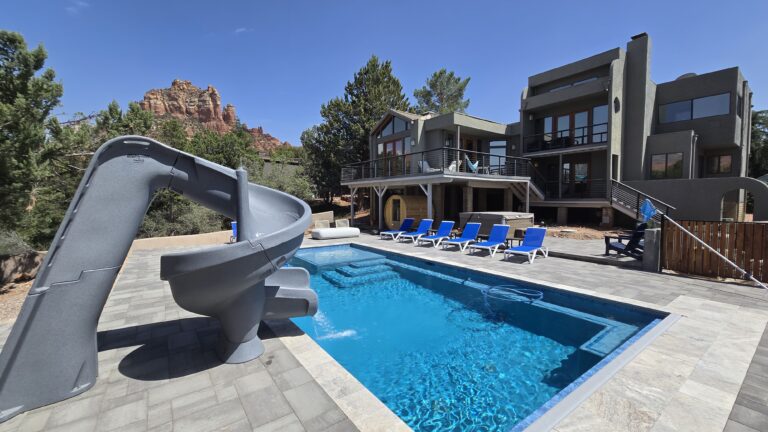
Our Sedona homes are the rare kind that give you more than the view. Every home has its own pool, spa and game room, five of the six are a short walk from Uptown Sedona, and all of them welcome dogs. Built for group trips, family reunions, and red rock weekends.
Best Time to Visit Sedona 2026
| Season | Typical Daytime Temps | Crowd Level | Best For |
| Spring (Mar–May) | Mid-60s to mid-80s°F | High, especially April/May | Wildflowers, ideal hiking weather, peak pricing |
| Summer (Jun–Aug) | High 80s to mid-90s°F | Lower on trails, busier at pools and Slide Rock | Early-morning hikes, water activities, lower hotel rates |
| Fall (Sep–Nov) | 70s to low 80s°F | High, especially October | Foliage in Oak Creek Canyon, comfortable hiking, wine season |
| Winter (Dec–Feb) | Upper 40s to low 60s°F | Lowest of the year | Quiet trails, occasional light snow on red rock, best hotel deals |
Multiple current sources point to October as close to the ideal single month, mild daytime highs in the low 70s, minimal rainfall, and cottonwood and sycamore foliage through Oak Creek Canyon.
May is the other strong contender, though both months carry premium pricing since they’re widely known as the sweet spot.
The Question We Get Asked Most: “Is Sedona too hot in summer?” No, not the way Phoenix is.
Because Sedona sits around 4,500 feet, summer highs typically run in the high 80s to mid-90s rather than Phoenix’s regular 105-plus days.
We tell every summer guest to hike by 8 a.m. and treat afternoons as pool and shade time.
Sedona Events Calendar 2026
| Event | Dates |
| Sedona International Film Festival | Feb 21 – Mar 1 |
| Sedona Yoga Festival | TBD (check festival site) |
| WagFest & Fair | Oct 3 |
| Sedona Arts Festival | Oct 10–11 |
| Sedona Plein Air Festival | Oct 16–24 |
| Sedona Mountain Bike Festival | Typically early November |
If your travel dates overlap with any of these, book both lodging and dinner reservations well ahead; we’ve seen guests get shut out of restaurant reservations during film festival week simply because they assumed a weekday visit wouldn’t need advance planning.
How Many Days Do You Need in Sedona?
| Trip Length | Who It’s For | What You’ll Realistically Cover |
| 2 days (weekend) | First-timers, quick getaways | One major hike, Uptown Sedona, one scenic drive, dinner reservation |
| 3 days | Most couples and first-time visitors | Two to three hikes, Tlaquepaque, Chapel of the Holy Cross, a jeep tour or wine tasting |
| 4 days | Guests who want a slower pace | All of the above plus Slide Rock, Oak Creek Canyon drive, a spa afternoon |
| 5+ days | Repeat visitors, families, remote workers | Grand Canyon day trip, Verde Valley wineries, multiple sunset spots, less rushing |
Our general advice: three days is the sweet spot for a first Sedona trip.
Two days work if you’re efficient and only want the highlights, but we’ve had more than one guest tell us they wished they’d booked an extra night once they saw how much driving between trailheads actually eats into a day.
Sedona Travel Guide Itinerary & Custom Trip Plans
Whether you are planning a quick weekend getaway or an extended desert retreat, these customizable Sedona itineraries ensure you experience the absolute best red rock hikes, scenic drives, and local spots.
The 3-Day Sedona Itinerary
Day 1: Arrival and Uptown Orientation
- Arrive, check into your rental, and unpack.
- Late-afternoon walk through Uptown Sedona’s shops and galleries.
- Sunset at Airport Mesa Overlook, a short five-minute drive from most West Sedona and Uptown rentals.
- Dinner reservation at a restaurant with red rock views.
Day 2: Hiking Day
- Early hike: Devil’s Bridge or Cathedral Rock.
- Lunch in West Sedona.
- Afternoon at Tlaquepaque Arts & Shopping Village.
- Optional sunset jeep tour if you’d rather not hike twice in one day.
Day 3: Oak Creek Canyon and Departure
- Morning drive up Oak Creek Canyon toward Slide Rock State Park.
- Stop at Chapel of the Holy Cross on the way back into town.
- Final lunch, last-minute shopping, and departure.
This is the framework we hand almost every guest who asks for a starting point, then adjust based on hiking ability, whether kids are along, and the season.
What to Do in Sedona for 4 Days
A fourth day unlocks the Verde Valley Wine Trail, a half-day trip to Palatki or Honanki Heritage Sites for ancient cliff dwellings, or a slower, less rushed version of the itinerary above with an actual rest afternoon at your rental’s pool.
Guests staying at our Starview Sedona property, near Tlaquepaque, often use their fourth day for a lazy morning by the pool followed by an afternoon wine tasting.
Sedona Weekend Trip Guide (Friday–Sunday)
- Friday evening: arrive, check in, sunset at Airport Mesa, casual dinner in Uptown or West Sedona.
- Saturday: early hike (Devil’s Bridge or Cathedral Rock, depending on fitness level and shuttle schedule), afternoon at Tlaquepaque, dinner reservation at Mariposa or Elote Cafe.
- Sunday: short scenic drive through Oak Creek Canyon, Chapel of the Holy Cross, lunch, and departure.
A weekend is genuinely enough to leave Sedona satisfied, though almost every guest who does the compressed version tells us afterward they wished they’d added a third day.
Sedona Day Trip Itinerary from Phoenix or Flagstaff
- From Phoenix, budget roughly 4 hours round trip in driving alone, leaving realistically 5–6 hours in Sedona for a full day.
- Prioritize one hike (Bell Rock Pathway if time is tight, since it requires a Red Rock Pass and no shuttle concerns) plus Tlaquepaque and one scenic overlook.
- From Flagstaff, the shorter 40-minute drive through Oak Creek Canyon makes a relaxed day trip genuinely feasible, with time for two shorter attractions plus a meal.
We’d still recommend at least one overnight if your schedule allows it; a day trip means constant time-checking, and it’s the number one thing former day-trippers tell us they’d change on a return visit.
Grand Canyon Day Trip from Sedona
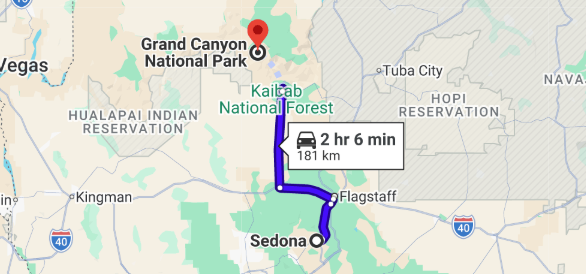
For guests staying five or more days, a Grand Canyon (South Rim) day trip is one of the most requested add-ons.
It’s roughly a 2–2.5 hour drive each way via Highway 89A through Flagstaff, so plan for a genuinely full day; leave by early morning and expect to be back after dark.
It’s a long day, but it’s the itinerary item guests tell us they’re most glad they didn’t skip.
Top 10 Things to Do in Sedona
- Hike Devil’s Bridge, the largest natural sandstone arch in the area.
- Hike or view Cathedral Rock, Sedona’s most photographed formation.
- Tlaquepaque Arts & Shopping Village; a Mexican village-style arts complex with more than 40 shops and galleries.
- Chapel of the Holy Cross: a chapel built into the red rock cliffs, free to visit.
- Slide Rock State Park: natural water slides in Oak Creek Canyon.
- Pink Jeep Tour or similar off-road tour; backcountry access without hiking.
- Scenic drive through Oak Creek Canyon on Highway 89A.
- Sunset at Airport Mesa or Bell Rock Vista.
- Verde Valley Wine Trail tasting; a short drive from Sedona proper.
- Vortex site visit at Bell Rock, Airport Mesa, or Boynton Canyon; worth the walk for the views regardless of what you believe about the energy claims.
Local Tip: Most visitors cram the top attractions into two rushed days. We’ve found guests enjoy Sedona far more when they pick three or four of the items above rather than trying for all ten.
Our SkyLine Sedona guests, for instance, are a five-minute drive from Uptown, so we usually suggest they walk to dinner after a hiking day rather than add another attraction on top.
Best Hikes in Sedona
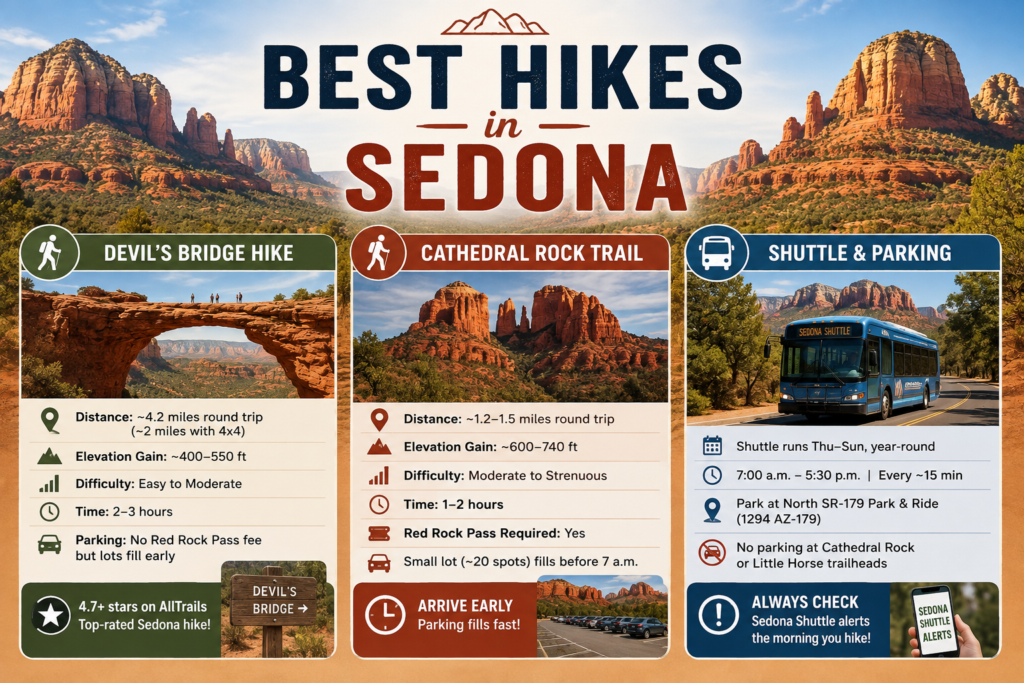
Sedona has more than 200 miles of trail, and no guide should pretend to cover all of it. What follows are the hikes our guests ask about most.
Devil’s Bridge Hike Sedona
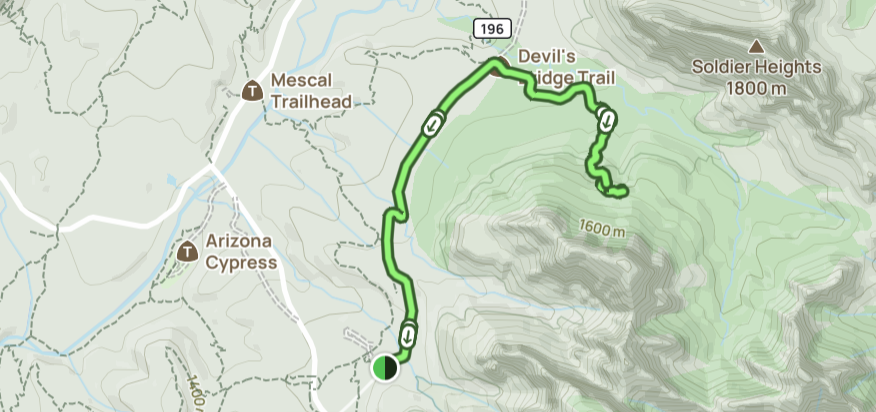
The largest natural sandstone arch in the Sedona area; the hike we get asked about more than any other.
- Distance: ~4.2 miles round trip from the Mescal Trailhead, or ~2 miles round trip with a high-clearance 4×4 driven to the Devil’s Bridge Trailhead itself.
- Elevation gain: ~400–550 feet.
- Difficulty: Easy to moderate, with one short, steep, rocky scramble near the top.
- Time: 2–3 hours for most hikers.
- Trailhead: Mescal Trailhead on Long Canyon Road has the larger lot; Dry Creek Trailhead is smaller and involves more walking on an open dirt road shared with vehicles.
- Parking: No Red Rock Pass fee currently applies at either trailhead, but lots fill early, and a free shuttle runs on set days.
Parking Reality Check: The Mescal Trailhead lot has roughly double the capacity of Dry Creek, and it skips the dusty, vehicle-shared dirt road that makes up much of the Dry Creek approach.
Aim for Mescal and arrive before 8 a.m., especially March–May and September–November, since both lots are known to fill solid by mid-morning.
Cathedral Rock Trail Guide
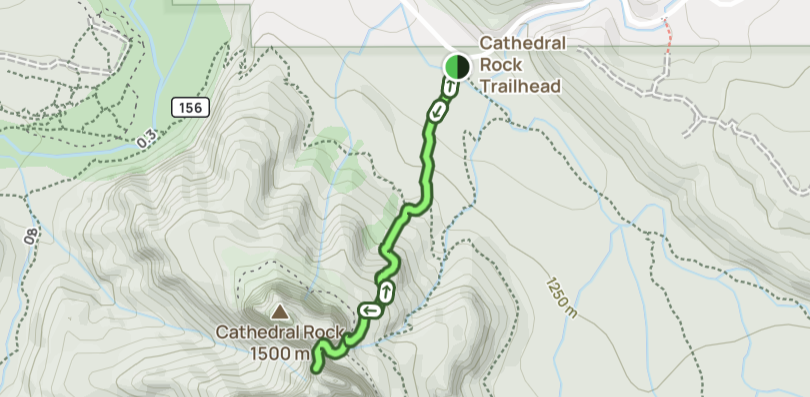
Sedona’s most photographed formation; the trail up to the saddle between its spires is short but genuinely strenuous.
- Distance: ~1.1 miles round trip, depending on how far you go.
- Elevation gain: ~669 feet, most of it packed into the final push.
- Difficulty: The U.S. Forest Service rates it moderate to strenuous; several sections require hand-and-foot rock scrambling on smooth sandstone.
- Time: 1–2 hours for most hikers.
- Red Rock Pass required: Yes, when you can drive to the lot at all.
The trailhead lot off Back O’Beyond Road holds only around 20 vehicles and regularly fills before 7 a.m., even outside peak season.
Sedona Shuttle Hiking Spots & Parking Rules
On the shuttle’s operating days, currently Thursday through Sunday, year-round, with extended daily service during spring break and select holidays, personal vehicles cannot park at the Cathedral Rock or Little Horse trailheads at all.
You must catch the free shuttle from the North SR-179 Park and Ride lot (roughly 1294 AZ-179).
The ride to the trailhead takes about 7–10 minutes; buses run roughly every 15 minutes during operating hours of 7 a.m. to 5:30 p.m., and there’s no reservation system or fee.
What Visitors Often Don’t Realize: Even guests who read about the shuttle beforehand often assume it only applies on weekends. It runs every Thursday through Sunday, all year, not just in peak season.
Route service can also shift due to wildfire activity, as it did in mid-2026 when a fire temporarily suspended one shuttle route to Soldier Pass and Dry Creek Vista.
Always check the live Sedona Shuttle alert page the morning you plan to hike.
Easier Hikes & Gentle Walking Trails
- Bell Rock Pathway: mostly flat, red rock pass required, good for a quick stop or a day-tripper with limited time.
- Fay Canyon Trail (first mile); quiet, shaded, and a good fit for families or solo hikers who want fewer crowds.
- West Fork Trail: a creek-bottom canyon hike in Oak Creek Canyon, especially scenic in fall.
Do You Need a Pass to Hike in Sedona?
Hiking itself never costs money in Coconino National Forest. What requires payment is parking at most trailheads, through the Red Rock Pass program.
| Pass Type | Cost | Covers |
| Daily Red Rock Pass | ~$5 | One day of parking at most Forest Service trailheads |
| Weekly Red Rock Pass | ~$15 | Seven days of trailhead parking |
| Annual Red Rock Pass | ~$20 | One year of trailhead parking |
| America the Beautiful Pass | ~$80/year | Most Forest Service trailheads, but not Slide Rock or Red Rock State Parks, or the five concessionaire day-use sites |
| Slide Rock State Park entry | ~$20–$30 per vehicle, varies by day/season | Only Slide Rock itself (a separate Arizona State Parks fee) |
| Red Rock State Park entry | ~$10 per adult, ~$5 ages 7–13, free 6 and under | Only Red Rock State Park (a separate, per-person Arizona State Parks fee) |
Passes are available at self-serve kiosks at most trailheads (credit card only at many locations), at the Sedona Chamber of Commerce Visitor Center in Uptown, at the Red Rock Ranger Visitor Center on SR-179, and online in advance through Recreation.gov.
Devil’s Bridge is a notable exception; currently, no Red Rock Pass fee is charged at either main trailhead, though that has changed before and could change again.
Quick photo stop? If you’re stopping for under 15 minutes, most sources indicate no pass is required. Beyond that window, or if you’re leaving your vehicle to hike, a pass is needed at most Forest Service trailheads.
Citations for skipping it have been reported in the $50–$150 range.
Sedona’s Two State Parks: Red Rock State Park vs. Slide Rock State Park
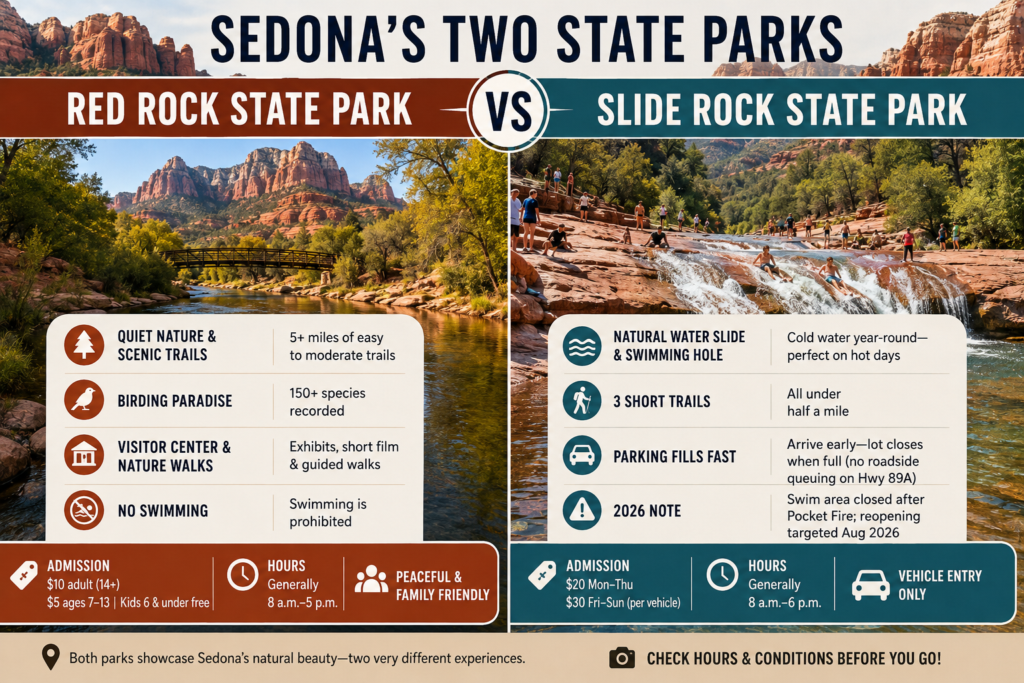
This is a gap in a lot of Sedona guides; the two state parks get confused constantly, and they’re genuinely different experiences.
Slide Rock State Park Tips & Visitors Guide
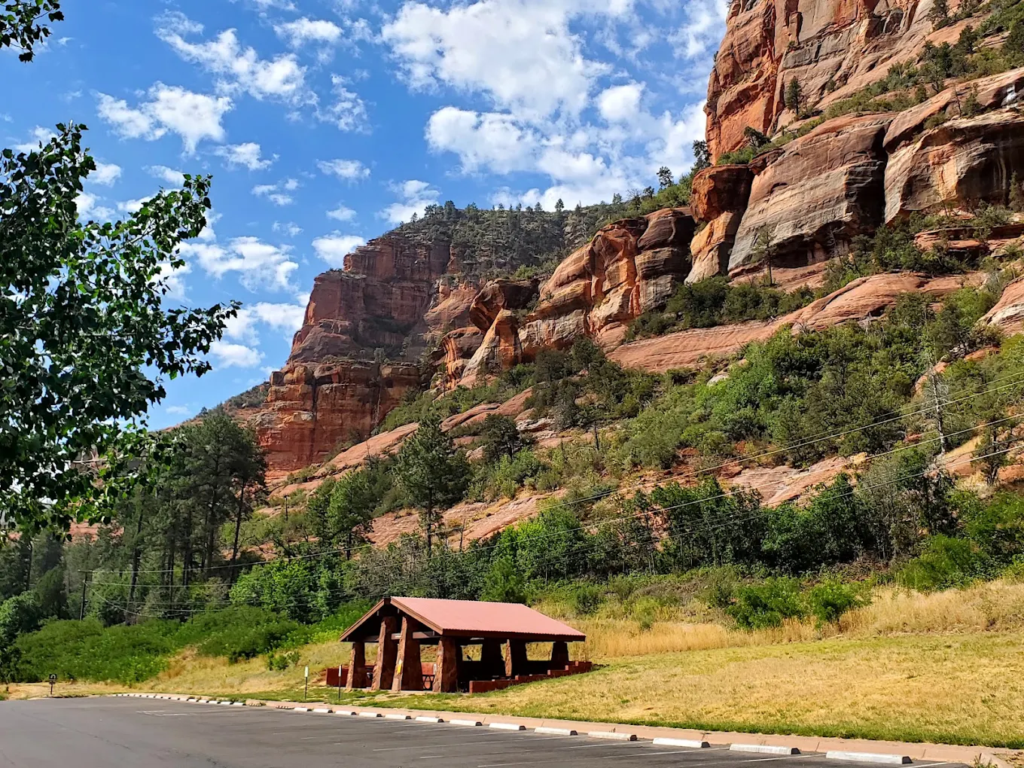
A former apple orchard turned natural water slide, located in Oak Creek Canyon roughly 15 minutes north of town; the classic swimming-hole trip.
- Admission: ~$20 per vehicle Monday–Thursday, ~$30 per vehicle Friday–Sunday, cash or card, vehicle entry only (no walk-ins).
- Hours: Generally 8 a.m.–6 p.m. late January through late November; shorter winter hours the rest of the year. Last entry is one hour before closing.
- Parking: The lot fills fast on summer weekends, and as of May 2026, vehicles can no longer queue on Highway 89A once the lot is full; it simply closes until space opens up.
- What’s inside: The natural rock slide itself, plus three short trails (Pendley Homestead Trail, Slide Rock Route, and Clifftop Nature Trail), each under half a mile.
Summer Heat Considerations: Slide Rock’s water stays cold even in July and August, which surprises a lot of our guests. Pack water shoes, since the rocks are slippery, and arrive right at opening on a summer weekend.
One 2026 note: the swim area was closed for flood-safety reasons following the Pocket Fire earlier in the year, with reopening targeted for early August 2026; worth checking current status before planning a full day around swimming.
Red Rock State Park Nature Trails
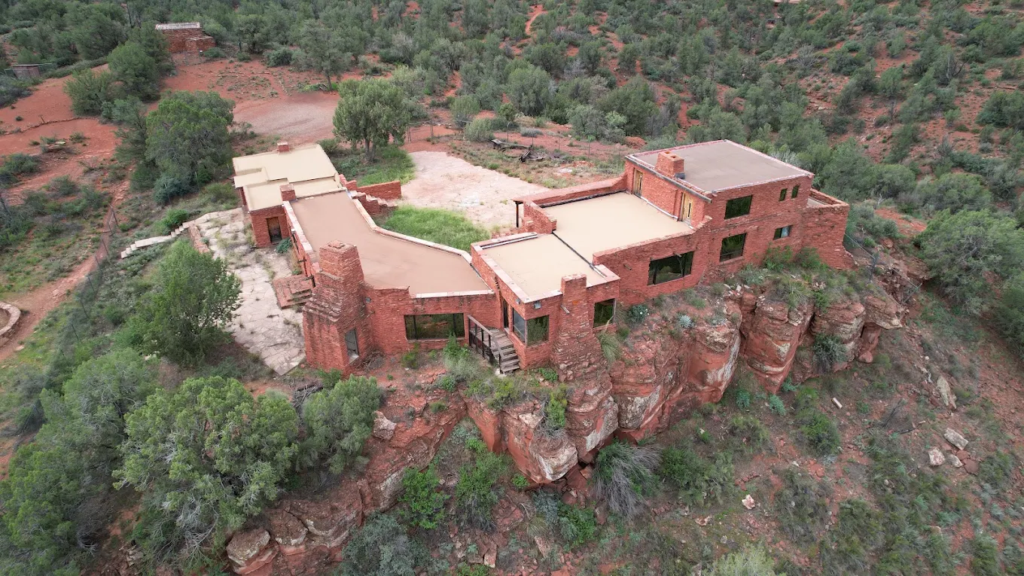
A 286-acre nature preserve on the south side of town, centered on a riparian stretch of Oak Creek; a much quieter, more contemplative alternative to Slide Rock, and the one most visitors skip without realizing what they’re missing.
- Admission: ~$10 per adult (14+), ~$5 for ages 7–13, free for kids 6 and under; charged per person, not per vehicle.
- Hours: Generally 8 a.m.–5 p.m., with shortened hours on some holidays. Check the park’s site for exact seasonal hours before you go.
- What’s inside: Over 5 miles of easy-to-moderate interpreted trails, a visitor center with exhibits and a short film, guided nature walks, and one of the best birdwatching spots in the region (150+ species recorded).
- What it doesn’t have: Swimming is prohibited here; if you want to get in the water, that’s Slide Rock, not this park.
- Why it’s worth adding: It’s a genuinely different pace than the scramble-heavy hikes on this list, and a strong pick for families with younger kids, photographers, or anyone who wants Sedona’s scenery without a steep climb.
Bottom line: Want to swim and slide? Go to Slide Rock. Want an easy, scenic, less crowded hike with wildlife and interpretive programs?
Go to Red Rock State Park. Both are worth it on a longer trip, and neither is covered by the Red Rock Pass or the America the Beautiful Pass.
Unique Things to Do in Sedona Without Hiking
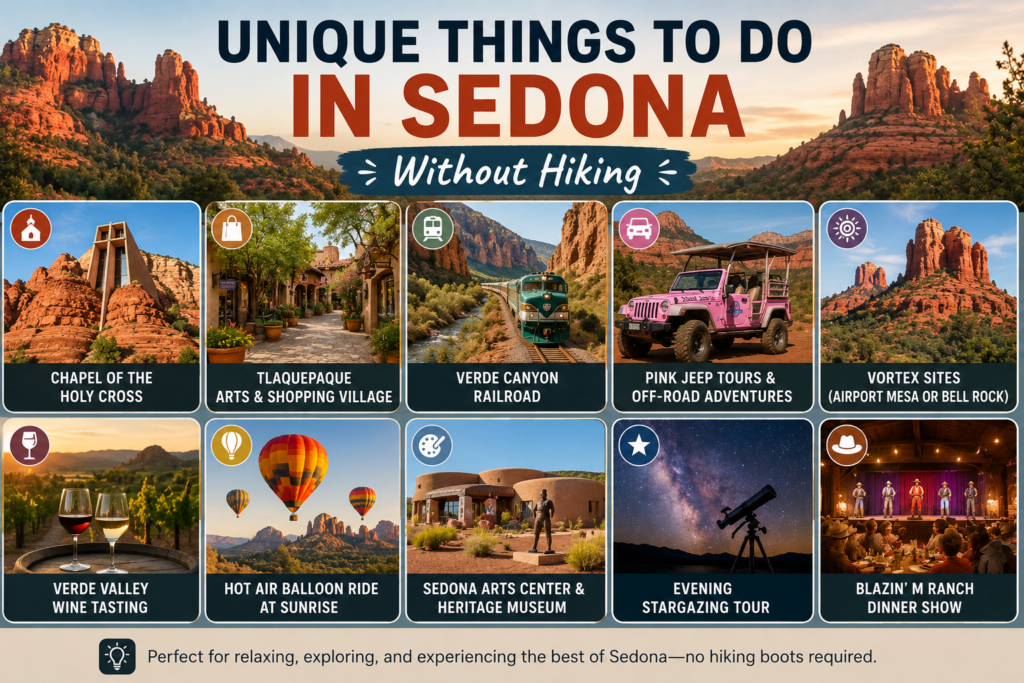
Not every guest wants to scramble up sandstone, and that’s completely fine.
- Chapel of the Holy Cross: a short paved walk from the parking area, wheelchair accessible in most sections, and free.
- Tlaquepaque Arts & Shopping Village: cobblestone paths, more than 40 galleries and shops, ideal for a slower afternoon.
- Verde Canyon Railroad: a roughly four-hour scenic train ride through Verde Canyon, about a 30-minute drive from Sedona in Clarkdale.
- Pink Jeep Tours or similar off-road companies cover backcountry terrain that would otherwise require miles of hiking.
- Vortex site visits at Airport Mesa or Bell Rock Vista; both are short, flat walks from the parking lot.
- Verde Valley wine tasting; multiple tasting rooms within a 20–30-minute drive of Sedona.
- Hot air balloon ride at sunrise; no hiking involved, and many guests call it the highlight of their trip.
- Sedona Arts Center and Sedona Heritage Museum; both are indoor and good options on a hot afternoon.
- Evening stargazing tour: Sedona’s dark skies and dry desert air make it a genuinely good spot for stargazing; several local operators run guided telescope sessions.
- Blazin’ M Ranch dinner show: a family-friendly Western dinner show just outside Cottonwood, popular with guests looking for an evening activity that isn’t a restaurant.
Free Things to Do in Sedona
Sedona can get expensive quickly between parking fees, jeep tours, and dining, so it helps to know what costs nothing.
- Chapel of the Holy Cross (free admission)
- Bell Rock Pathway and views from the roadside pullouts along Highway 179
- Tlaquepaque browsing, even if you don’t buy anything
- Airport Mesa sunset viewing
- Uptown Sedona window shopping and people-watching
- The Sedona Farmers Market, typically running spring through fall
- Amitabha Stupa and Peace Park, a quiet garden and meditation site west of town
Hidden Gems & Photography Spots in Sedona

Beyond the headline hikes, a few spots our guests and other locals point to for a quieter Sedona experience:
- Lover’s Knoll: a sunset viewpoint that requires no hiking at all, a good pick for anyone who wants the golden-hour views without the trail.
- Birthing Cave: a short, easy walk to a natural rock alcove that frames the red rocks like a window; a favorite for photographers.
- Schnebly Hill Road: a rugged backroad with some of the best elevated views in the area; a high-clearance 4×4 is strongly recommended.
Photography tip: A telephoto lens (roughly 70–200mm) compresses the landscape and makes the red rocks look larger behind a subject.
Blue hour, just after sunset, gives a soft, even glow that avoids the harsh shadows of midday shooting.
Romantic Getaway Sedona: Things to Do in Sedona for Couples
Sedona draws a genuinely high volume of couples, and honeymooners in particular. When guests tell us they’re celebrating an anniversary, we usually point them toward:
- A sunset dinner reservation at a restaurant with red rock views.
- A private jeep tour at golden hour rather than midday.
- A spa treatment at one of the resort spas around town.
- A quiet, less-crowded hike like Fay Canyon rather than the more social atmosphere at Devil’s Bridge.
- Chapel of the Holy Cross at sunset, when the light hits the red rock walls directly.
Best for: Romantic getaways work best in shoulder season, spring or fall, when temperatures are comfortable enough for an evening walk, but crowds haven’t peaked.
Several of our properties, including Uptown Sparks and Uptown Splash, have private hot tubs and fire features that couples use most evenings of their stay rather than heading back out.
Sedona Family Vacation Guide
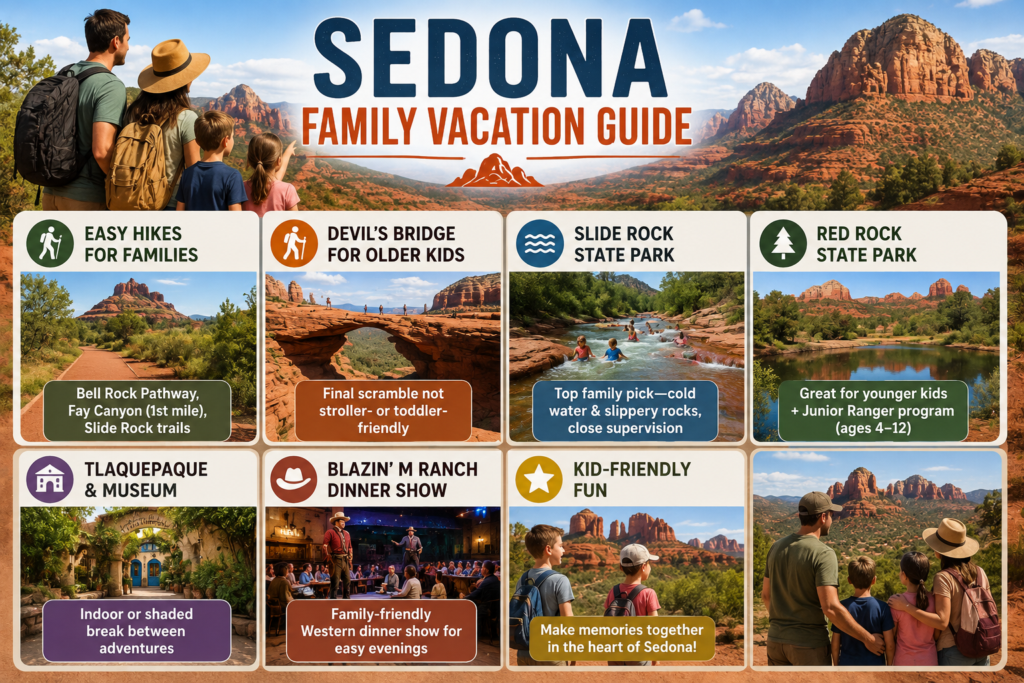
Traveling with kids changes which hikes and attractions make sense.
- Easier hikes for families: Bell Rock Pathway (mostly flat), the first mile of the Fay Canyon Trail, and the shorter Slide Rock nature trails.
- Devil’s Bridge works for families with older kids or experienced young hikers, but the final scramble is not stroller- or toddler-friendly.
- Slide Rock State Park is consistently one of the top family picks, though the cold water and slippery rocks mean close supervision matters.
- Red Rock State Park is a good lower-intensity alternative for younger kids, with a Junior Ranger program for ages 4–12.
- Tlaquepaque and the Sedona Heritage Museum give kids an indoor or shaded break between outdoor activities.
- Blazin’ M Ranch offers a family-friendly Western dinner show for an easy evening with younger kids.
Properties with a private pool, like all five of our Stay Wandery homes, tend to matter more for families than for solo travelers or couples, since a mid-afternoon pool break can save an otherwise overheated kid-filled day.
Solo Travel Sedona Tips
Solo travelers ask us about safety and logistics more than any other group.
- Popular trails like Devil’s Bridge and Cathedral Rock are busy enough that solo hikers are rarely isolated, especially during daylight hours.
- Less trafficked trails, like the far end of Boynton Canyon or the Hiline Trail loop, are better suited to hikers with more backcountry experience and ideally a hiking partner or a tell-someone-your-plan approach.
- A rental car is close to essential; Sedona’s public transit options are limited to the trailhead shuttle system.
- Solo diners have no trouble getting seated at most Sedona restaurants, though the most in-demand sunset tables at places like Mariposa are typically reserved for two or more.
Best Restaurants in Sedona, AZ
A short, honest list of where our guests consistently rave about their meals.
- Elote Cafe: Modern Mexican and Southwestern cooking from chef Jeff Smedstad, known for its fire-roasted street corn and smoked pork cheeks. No reservations are taken, so the wait-list line forms before the 5 p.m. opening on busy nights.
- Mariposa Latin Inspired Grill: Chef Lisa Dahl’s Latin-inspired fine dining spot with a wraparound patio facing Capitol Butte, widely regarded as one of the best sunset dinner views in town. Reservations open 30 days out, and the best patio tables go within minutes.
- Tii Gavo at Enchantment Resort: Southwestern and Native-inspired dishes served on a firepit-lined terrace inside Boynton Canyon, worth the scenic drive in on its own.
- The Hudson: An upscale but casual neighborhood spot open for lunch and dinner, a reliable choice when the more famous spots are booked out.
- Coffee Pot Restaurant: A longtime local breakfast institution in West Sedona known for its long list of omelets, ideal fuel before a morning hike.
- ChocolaTree Organic Oasis: Fully organic, largely vegan and vegetarian menu with a garden patio, a good option for guests with dietary restrictions.
What We Tell Our Guests: Book Mariposa the moment your travel dates are confirmed, not the week before.
Their online booking window opens 30 days in advance at midnight Mountain Time, and the sunset-facing tables are typically gone within minutes.
If you miss the window, calling the morning of your desired date to ask about cancellations has worked for several of our guests.
What to Pack for a Sedona Trip
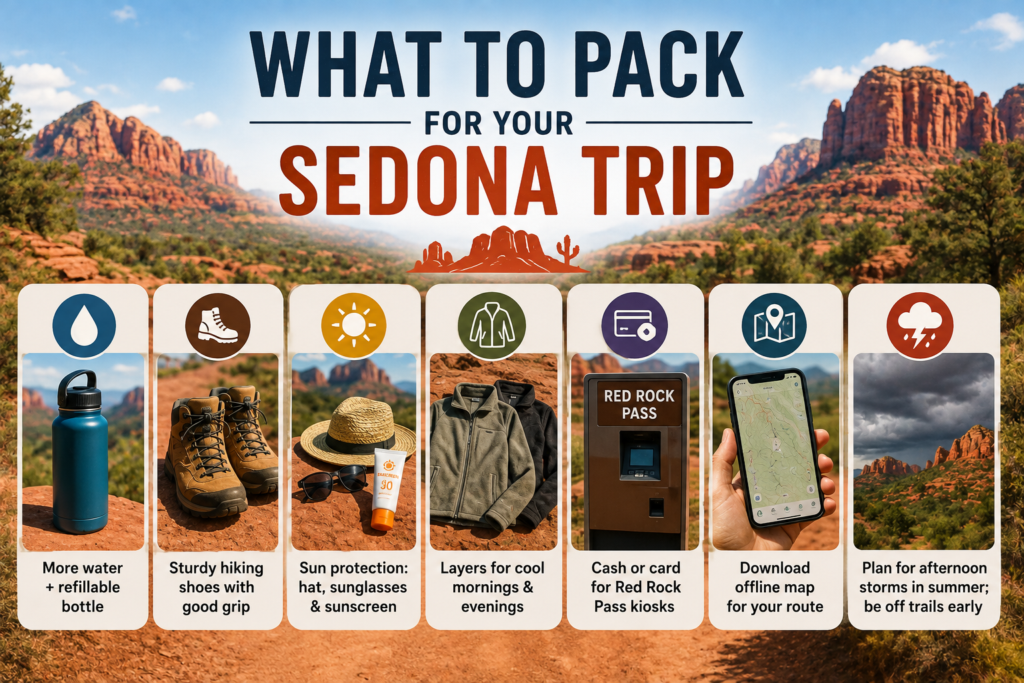
- More water than you think you’ll need, plus a refillable bottle; the exposed sandstone reflects heat and dehydration sneaks up fast.
- Sturdy hiking shoes with good grip; several trails involve smooth, sloped sandstone that gets slippery even when dry.
- Sun protection: hat, sunglasses, and sunscreen, even on cooler days at 4,500 feet elevation.
- Layers: mornings and evenings run noticeably cooler than midday, especially in shoulder season and winter.
- Cash or a card that works at unmanned kiosks for Red Rock Pass machines at trailheads without cell signal.
- A downloaded offline map for the day’s route, since cell service drops out in the canyons and on backroads.
- Afternoon monsoon storms in July and August can bring sudden lightning and flash-flood risk in canyon areas; plan to be off exposed trails by early afternoon in summer.
Is Sedona Expensive to Visit?
Sedona sits toward the higher end of Arizona travel costs, driven mostly by lodging and dining rather than activities.
- Lodging: Hotel rates commonly range from ~$260–$350 per night in shoulder season, with spring peak pricing running higher. Vacation rentals vary widely by size and amenities.
- Food: Expect ~$15–$25 per person for casual lunches and ~$40–$70 per person for a sit-down dinner at a scenic restaurant like Mariposa.
- Activities: Hiking itself is free. Parking passes run ~$5–$20. Jeep tours typically range from ~$49–$190 per person. Slide Rock admission runs ~$20–$30 per vehicle; Red Rock State Park runs ~$10 per adult.
- How to control costs: Visiting in winter, splitting a larger vacation rental among a group rather than booking multiple hotel rooms, and prioritizing the free attractions listed above can all bring the total trip cost down meaningfully.
Sedona Travel Restrictions 2026: What’s Different This Year
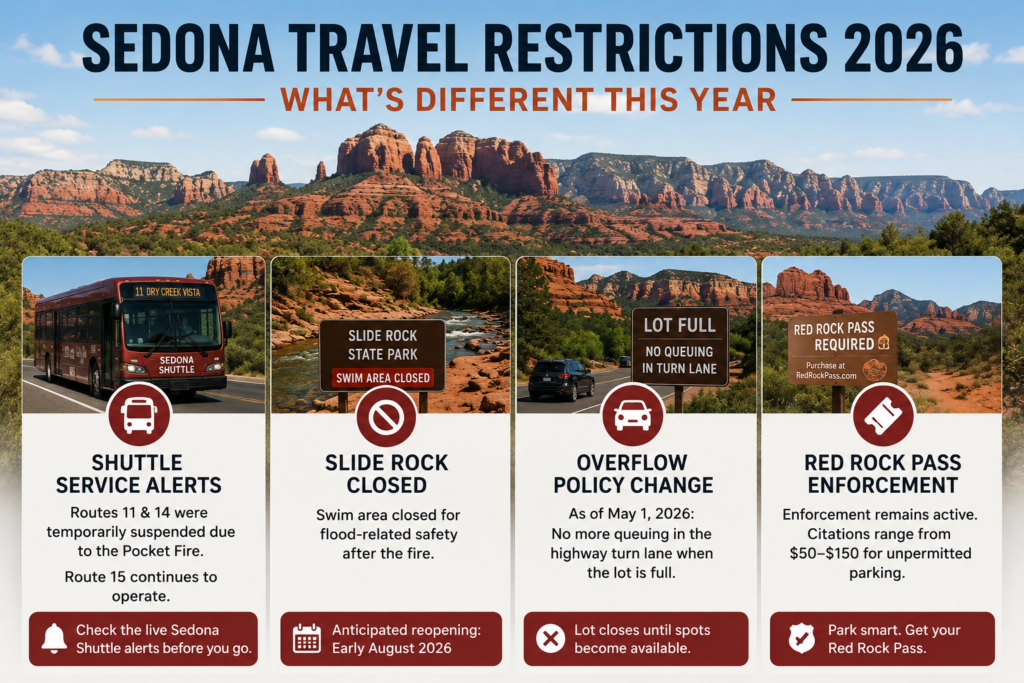
- The Pocket Fire earlier in 2026 temporarily affected Sedona Shuttle Route 11 (Dry Creek Vista and Mescal) and Route 14 (Soldier Pass).
- Some service was suspended for a period, with Route 15 to Cathedral Rock and Little Horse continuing to operate. Always check the live Sedona Shuttle alert page before your trip.
- Slide Rock State Park’s swim area was closed for flood-related safety reasons after the same fire, with an anticipated reopening in early August 2026.
- As of May 1, 2026, Slide Rock State Park changed its overflow policy: vehicles can no longer queue in the highway turn lane once the lot is full. The lot simply closes until enough spots free up.
- Enforcement of the Red Rock Pass program remains active, with citations reported in the $50–$150 range for unpermitted parking at posted Forest Service trailheads.
Choose This / Skip This: Quick Decision Guide
- Choose Devil’s Bridge if you want Sedona’s most famous single hike, don’t mind crowds, and are comfortable with one steep scramble near the top.
- Skip Devil’s Bridge if you’re hiking with very young children or have significant mobility concerns; the final approach involves narrow rock ledges.
- Choose Cathedral Rock if you want the most dramatic short hike in town and don’t mind a genuinely strenuous scramble.
- Skip Cathedral Rock if you’re not comfortable with hand-and-foot rock climbing, or if you’re visiting Thursday through Sunday without checking the shuttle schedule first.
- Choose Slide Rock State Park if you’re traveling with kids or want a classic Arizona swimming-hole experience.
- Skip Slide Rock if you’re visiting on a summer weekend without an early arrival plan, since overflow parking is no longer an option as of the 2026 policy change.
- Choose Red Rock State Park if you want an easier, less crowded hike with strong birdwatching and photography opportunities.
- Skip Red Rock State Park if your main goal is swimming; that’s Slide Rock, not this one.
Bringing Your Sedona Trip to Life
Sedona rewards travelers who plan around its logistics as much as its scenery. Knowing which trailheads require the shuttle, which passes actually apply where, and which season fits your tolerance for heat or crowds will shape your trip far more than any single attraction on a list.
Whether you’re building a tight weekend around Devil’s Bridge and Tlaquepaque or a slower five-day trip that adds a Grand Canyon run and the Verde Valley wine trail, the framework in this guide should get you there with fewer surprises for first-time guests.
If you’re looking for a base for any version of this trip, our five Stay Wandery properties across Sedona’s Uptown corridor each offer a private heated pool, spacious group-friendly layouts, and a short drive or walk to most of what’s covered here.
We’re happy to help match the right property to your group size and travel dates.
FAQs | The Complete Sedona Travel Guide (2026)
1. Do I really need a Red Rock Pass just to park for a few minutes?
If you’re stopping for a quick photo for about 15 minutes or less, most sources indicate no pass is required. Beyond that window, or if you’re leaving your vehicle to hike, a Red Rock Pass or qualifying America the Beautiful Pass is needed at most Forest Service trailheads. Citations for skipping it have been reported in the $50–$150 range, so it’s not worth the risk for a short hike.
2. Is the Sedona Shuttle actually mandatory, or is it just recommended?
For certain trailheads, including Cathedral Rock and Little Horse, it is mandatory on operating days; currently Thursday through Sunday year-round, with extended hours during spring break and holidays. The parking lots are physically closed to personal vehicles during those hours, so there’s no way around it beyond using the free shuttle from the North SR-179 Park and Ride lot.
3. What’s the difference between Dry Creek and Mescal Trailheads for Devil’s Bridge?
Mescal has roughly double the parking capacity, and its first mile follows a scenic single-track trail away from vehicle traffic. Dry Creek’s route spends more time on an open dirt road shared with 4×4 tour vehicles, which many hikers find less pleasant, though the total distance is similar either way.
4. What’s the actual difference between Red Rock State Park and Slide Rock State Park?
Red Rock State Park is a quieter nature preserve with easy interpreted trails and no swimming; Slide Rock State Park is the natural water-slide swimming spot. They’re separate parks with separate entrance fees, and neither is covered by the Red Rock Pass.
5. Can I bring my dog on the Cathedral Rock hike?
Technically, dogs are allowed, but several current trail guides explicitly discourage it because of the steep, exposed rock scrambling involved. Easier trails like Bell Rock Pathway or Fay Canyon are better matches for dogs.
6. Is Slide Rock State Park worth the entrance fee compared to just hiking along Oak Creek?
It depends on your priorities. Slide Rock offers a maintained, historically significant site with the actual natural rock slide feature, while free roadside pullouts along the creek nearby offer wading without the fee. Families specifically wanting the slide experience generally find the ~$20–$30 per vehicle fee worthwhile.
7. How far in advance should I book a table at Mariposa?
Their reservation system opens 30 days out at midnight Mountain Time, and sunset-facing patio tables are commonly gone within minutes of that window opening. If your trip dates are set, set a reminder for that exact moment.
8. Is it better to fly into Phoenix or Flagstaff for a Sedona trip?
Phoenix Sky Harbor offers dramatically more flight options and typically lower fares despite being roughly two hours away by car, versus Flagstaff’s 40–45 minute drive but limited, often pricier regional flights that frequently connect through Phoenix anyway. Most of our guests fly into Phoenix.
9. Are the energy vortex sites worth visiting if I’m skeptical?
Even setting aside the spiritual claims, sites like Airport Mesa, Bell Rock, and Boynton Canyon are simply scenic overlooks with short, easy walks, so they’re worth a stop for the views regardless of what you believe about the vortex energy itself.
10. What should I pack for a Sedona hike in summer?
More water than you think you’ll need, sun protection, and a plan to be off the trail before late morning. The exposed sandstone reflects heat, and afternoon monsoon storms in July and August can bring sudden lightning and flash-flood risk in canyon areas.
Sources Consulted:
- Coconino National Forest / U.S. Forest Service official trail and Red Rock Pass pages
- Arizona State Parks official Slide Rock State Park and Red Rock State Park pages
- Visit Sedona (official Sedona tourism site) events calendar and Red Rock Pass Q&A
- Sedona Shuttle official routes and alerts pages
- AllTrails trail data and current reviews for Devil’s Bridge and Cathedral Rock
- Google Maps drive-time and distance data for airports and trailheads
- Local Sedona travel blogs and hospitality resources cross-checked for 2026 accuracy
- Our team’s operational experience hosting guests at Stay Wandery, Sedona