
Written by the Stay Wandery Editorial Team | Luxury Vacation Rental Properties, Sedona, Arizona | Updated November 2026
This guide is based on our experience as the team behind Stay Wandery in Sedona. Every week, guests ask us how to get to the Grand Canyon, which road to take, and whether they can make it a day trip. The recommendations here combine our firsthand local insight with thorough research into current routes, road conditions, and park access to help you plan a drive that actually goes the way you expect.
Disclosure: Stay Wandery properties are our own vacation rentals, so they are featured because we know them best through daily operations and guest feedback. We also encourage you to explore the other lodging and travel options mentioned throughout this guide to find what best matches your plans. Route and seasonal information reflects the latest data available as of November 2026, though road conditions and park operations can change. We review and update this guide regularly to keep it accurate.
Driving from Sedona to the Grand Canyon
The Sedona to Grand Canyon drive is shorter than most first-time visitors expect, and longer than the map suggests once you account for Oak Creek Canyon’s switchbacks.
We hear this question almost daily at check-in: “Can we really do the Grand Canyon and get back to Sedona for dinner?” The honest answer depends on which route you take and how many stops you make along the way.
We are not travel bloggers. Our team manages five vacation rental properties in Sedona and talks with guests planning this exact trip every week of the year.
Below is what we actually tell them, based on current road conditions, entrance fees, and the realistic drive time, not the optimistic number a map app shows you before traffic.
How Far Is the Grand Canyon From Sedona? Distance at a Glance
So how far is Grand Canyon from Sedona, exactly? It depends entirely on which road you take out of town, and the two main options differ by close to 20 miles.
| Route | Approx. Distance | Approx. Drive Time (no stops) | Best For |
| SR 89A through Oak Creek Canyon to US-180 | ~117 miles | 2 hours 15 min to 2 hours 30 min | Scenery, first-time visitors |
| I-17 South to I-40 West (bypasses Oak Creek Canyon) | ~145 miles | 2 hours 25 min to 2 hours 40 min | RVs, trailers, winter driving |
A few things worth knowing before you commit to a route:
- Both routes land you at roughly the same drive time despite the mileage gap, since I-17 and I-40 allow much higher speeds than the canyon road.
- Mileage and time estimates vary slightly across mapping services and traveler reports, so treat these as approximate rather than fixed.
- Neither figure includes stops, and most guests add at least 45 minutes for photos, gas, or a bathroom break in Flagstaff.
What we tell guests: if this is your first trip north from Sedona, the Oak Creek Canyon route is worth the extra minutes.
If you have already seen the canyon drive or you are towing something, the interstate route is the more relaxed choice.
Best Route From Sedona to Grand Canyon South Rim: 89A or I-17
This is one of the most common questions we get from guests standing in our kitchen with a paper map. There is no single correct answer, but there is a correct answer for your trip.
Route 1: Highway 89A Through Oak Creek Canyon (the scenic route)
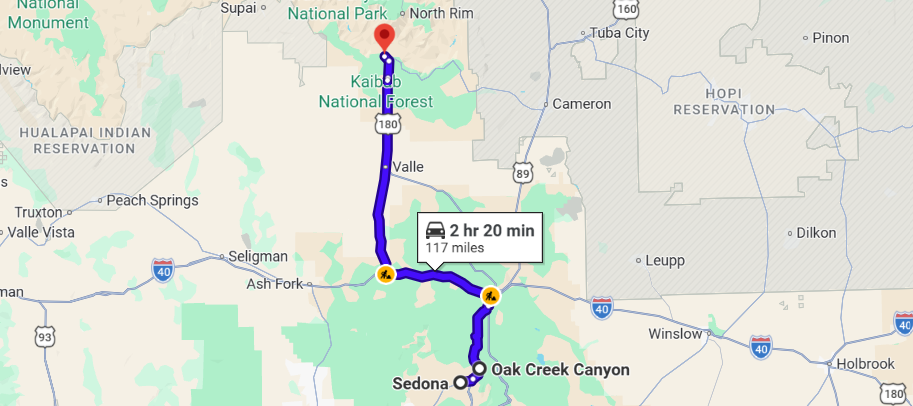
- Head north on SR 89A through Oak Creek Canyon to Flagstaff.
- Connect to US-180 North toward the South Rim.
- Merge onto AZ-64 for the final stretch into Grand Canyon Village.
- Two-lane road with tight switchbacks near the top of the canyon, climbing roughly 2,550 feet from Sedona to Flagstaff.
Route 2: I-17 South, Then I-40 West (the faster, wider road)
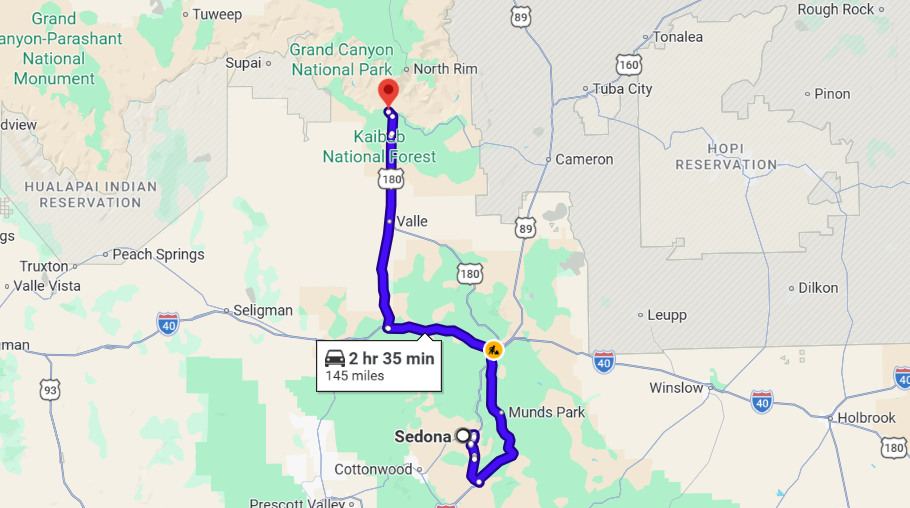
- Head south from Sedona to connect with I-17 toward Flagstaff.
- Take I-40 West toward Williams.
- Pick up AZ-64 North at Williams into the South Rim entrance.
- Wider, straighter interstate driving with higher speed limits and fewer curves.
Choose 89A if: you want the classic red rock to pine forest scenery, you are comfortable with mountain switchbacks, and you are not driving anything oversized.
Choose I-17/I-40 if: you are driving an RV, towing a trailer, traveling after dark, or driving in winter weather. It is also the more forgiving route if anyone in the car gets carsick on curvy roads.
Local Tip: Guests staying with us near Uptown often ask which route saves the most time. It rarely comes down to time. It comes down to comfort.
If you are unsure, ask yourself whether you would rather drive curves or drive speed, because both routes land you at the South Rim in a similar window.
Is the Drive From Sedona to Grand Canyon Scary? What Guests Actually Ask Us
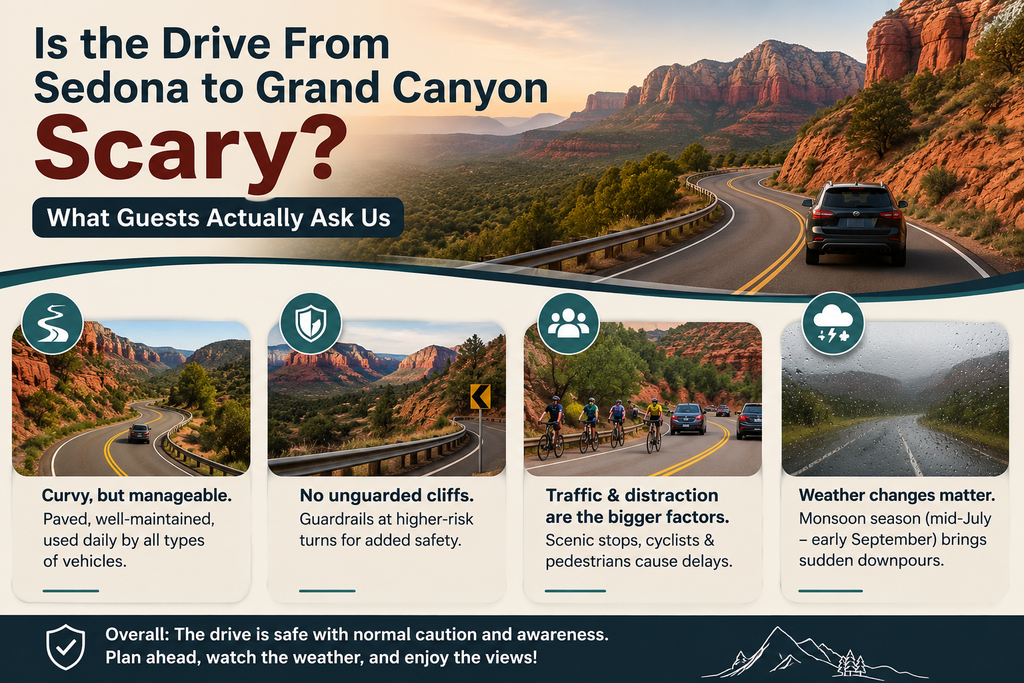
We get some version of this question from nearly every group heading north for the first time, usually phrased carefully: is the drive from Sedona to Grand Canyon scary, or am I overthinking this?
Here is our honest answer, based on hosting guests who make this drive constantly.
- The curves in Oak Creek Canyon are sharper than many people expect from photos, but the road is paved, well maintained, and used daily by everyone from delivery trucks to school buses.
- There are no unguarded cliff edges comparable to some mountain roads in other states. Guardrails exist at the higher-risk turns.
- The bigger concern is not danger; it is traffic and distraction. Drivers slowing to look at the scenery, combined with cyclists and pedestrians near Slide Rock, create more stop-and-go moments than actual hazard.
- Rain, snow, and monsoon storms change the equation. Northern Arizona’s monsoon season runs from roughly mid-July through early September, and sudden downpours can reduce visibility quickly on the canyon curves.
Please note that due to the recent Pocket Fire along SR 89A, several popular recreation areas in Oak Creek Canyon, including Grasshopper Point, Bootlegger, and Encinoso, are currently closed until further notice.
Planning your trip? Read our Sedona Travel Guide for helpful local tips on navigating red rock traffic, parking, and seasonal driving conditions.
Is the drive from Sedona to Grand Canyon safe overall? Yes, for an attentive driver in normal conditions.
If you are nervous about mountain curves specifically, the I-17/I-40 route removes that variable entirely and gets you to the same destination.
The Question We Get Asked Most: “Is it a hard drive?” We tell every guest the same thing. It is not a hard drive; it is a slow drive.
Give yourself more time than a map app suggests, keep a safe following distance on the curves, and you will be fine.
Most anxiety about this route comes from photos of the switchbacks online, which look more dramatic than they feel behind the wheel.
Places to Visit Between Sedona and Grand Canyon: Sedona to Grand Canyon Road Trip Stops
One of the best parts of this drive is that the destinations along the way are worth the trip on their own.
Here are the road trip stops we point guests toward most often, in roughly the order you will reach them heading north on 89A.
| Stop | Approx. Distance From Sedona | What It’s Known For |
| Slide Rock State Park | ~7 miles | Natural water slide in Oak Creek; verify USFS closure orders and water quality advisories before visiting |
| Flagstaff (Historic Downtown) | ~30 miles | Restaurants, gas, restrooms, Route 66 history |
| Sunset Crater Volcano National Monument | ~45 miles from Sedona | Cinder cone volcano and lava fields, roughly 1,000 years old |
| Wupatki National Monument | ~50 to 55 miles from Sedona | Ancestral Puebloan pueblo ruins with Painted Desert views |
| Cameron Trading Post | ~90 miles from Sedona (via US-89) | Historic Navajo trading post, dining, and gift shop |
A few notes on these stops:
- Sunset Crater and Wupatki share a combined entrance fee of approximately $25 per vehicle, valid for seven days at both sites.
- Cameron Trading Post holds a strong reputation among road trippers on Tripadvisor for its Navajo tacos and authentic Native-made goods, and it makes a natural stop if you take the US-89 approach toward the East Entrance.
- Flagstaff sits at a noticeably higher, cooler elevation than Sedona, so it is a smart place to fill up on gas and layer up if you are visiting outside summer.
If you are staying at one of our Uptown properties, like Uptown Sparks! or Uptown Splash!, you are already positioned right at the start of 89A, which means no extra driving through town before you even reach the canyon road.
Guests tell us that head start matters more than they expected once they are trying to beat the afternoon crowds at Slide Rock.
Sedona to the Grand Canyon Day Trip: Can You Do It in One Day?
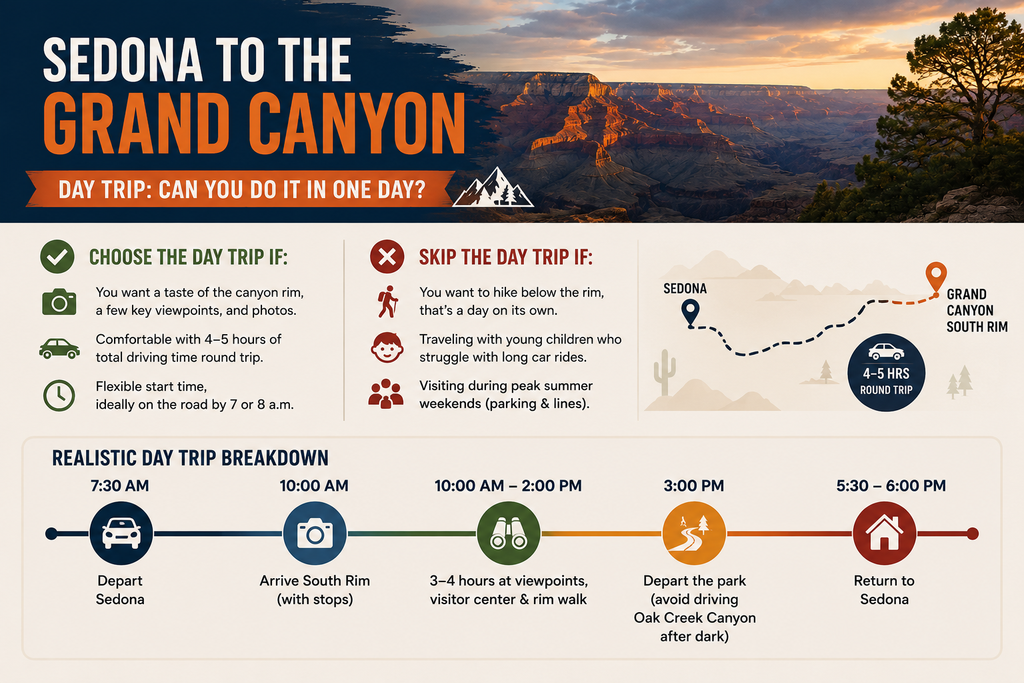
Can you do a day trip from Sedona to Grand Canyon and actually enjoy yourself, or is it too rushed? This depends on what you want out of the day.
Choose the day trip if:
- You want a taste of the canyon rim, a few key viewpoints, and photos, without an overnight stay.
- You are comfortable with 4 to 5 hours of total driving time round trip.
- Your group can be flexible about start time, ideally on the road by 7 or 8 a.m.
Skip the day trip if:
- You want to hike below the rim, since that alone can take most of a day.
- You are traveling with young children who struggle with long car rides.
- You are visiting during peak summer weekends, when parking and shuttle lines eat into your limited time at the rim.
Here is a realistic day trip breakdown we walk guests through:
- Depart Sedona by 6:30 a.m. (NPS advises arriving at the entrance station before 9:30 a.m. or after 4:00 p.m., as peak summer and spring break queue times can reach up to two hours between those hours).
- Arrive at the South Rim entrance by roughly 9:00 a.m., beating the peak gate delays.
- Spend 3 to 4 hours at the viewpoints, visitor center, and a short rim walk without losing precious time in line.
- Depart the park by 3:00 p.m. to avoid driving Oak Creek Canyon after dark.
- Return to Sedona by roughly 5:30 to 6:00 p.m.
Pro Tip: Wondering how to fit this drive into your larger trip? Check out How Many Days in Sedona to see how to balance a Grand Canyon day trip with local hiking and sightseeing.
Worth the Extra Drive? Guests often ask if a single-day Grand Canyon trip from Sedona is worth the time in the car.
Our honest take: yes, for most travelers, especially if the Grand Canyon has always been on your list.
You will not see everything, but you will stand at the rim, and for a lot of guests that is the whole point of the trip.
Sedona to Grand Canyon South Rim by Car vs Tour Bus vs the Train
There is more than one way to make this trip, and each option fits a different kind of traveler.
| Option | Approx. Cost | Approx. Duration | Best For |
| Self-drive (Sedona to Grand Canyon South Rim by car) | Gas plus $35 park entrance fee per vehicle (plus $100 per person aged 16+ for non-U.S. residents) | 4.5 to 5.5 hours round trip | Flexibility, photo stops, families with a rental car |
| Guided tour bus from Sedona | Roughly $300 to $400+ per adult | 10 to 11 hours, door to door | Travelers without a car, or who prefer someone else to drive |
| Grand Canyon Railway from Williams | Roughly $120 to $300+ per adult depending on class | About 4 hours round trip on the train, plus travel time to Williams | A relaxed, scenic alternative once you are already near Williams |
A note on the Sedona to Grand Canyon train option: the historic Grand Canyon Railway departs from Williams, Arizona, not Sedona itself, so you will still need to drive roughly an hour from Sedona to Williams first.
Several tour operators package a Sedona hotel pickup with the train ride into a full 10 to 11 hour experience, which removes the driving entirely but comes at a noticeably higher price point than self-driving.
What we tell our guests: if you already have a car and are comfortable with a few hours behind the wheel, driving yourself is by far the most economical and flexible option.
The Sedona to Grand Canyon tour bus and train options are worth it mainly for travelers who specifically want the experience of not driving, or who are combining the trip with a Williams overnight.
Sedona to Grand Canyon East Entrance: The Desert View Route
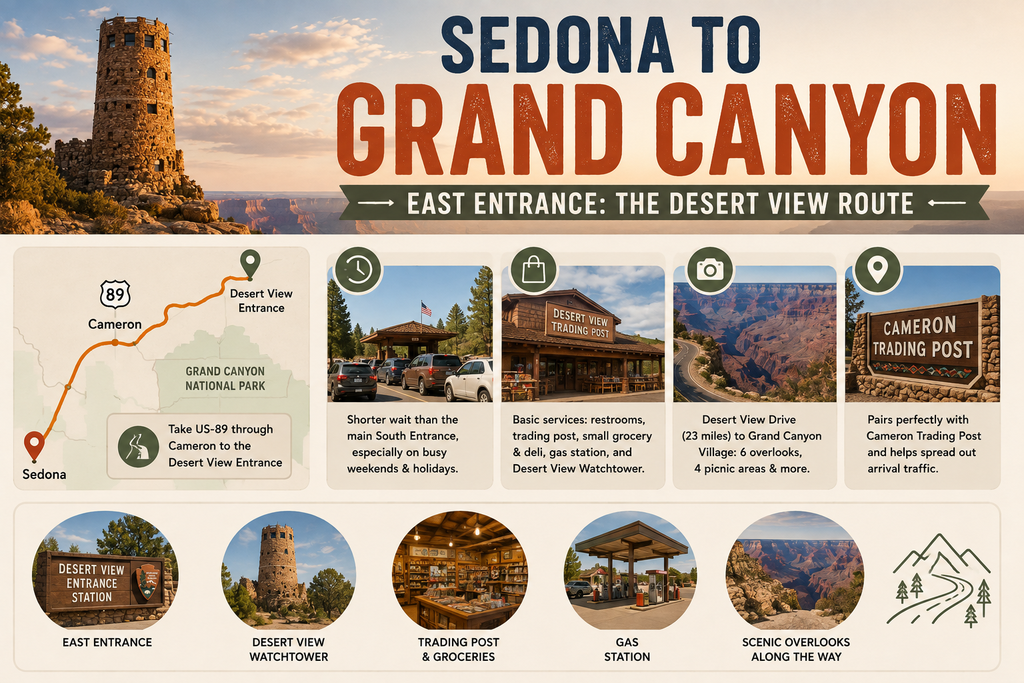
Most guides point everyone toward the main South Entrance near Tusayan, but the East Entrance at Desert View deserves more attention than it gets.
This route runs through Cameron via US-89, then enters the park at the Desert View Entrance Station.
- Entering from Desert View can mean a shorter wait than the main South Entrance Station, particularly during holidays, weekends, and peak summer months.
- Desert View offers basic services including restrooms, a trading post, a small grocery and deli, a gas station, and the historic Desert View Watchtower.
- From Desert View, the 23-mile Desert View Drive leads toward Grand Canyon Village, passing six developed overlooks, four picnic areas, and several unmarked scenic pullouts along the way.
If you are combining a Cameron Trading Post stop with your drive, entering at Desert View simply makes more geographic sense than backtracking to the main entrance, and it spreads out arrival traffic during the busiest travel windows.
Sedona to Grand Canyon North Rim: Distance, Route, and 2026 Access
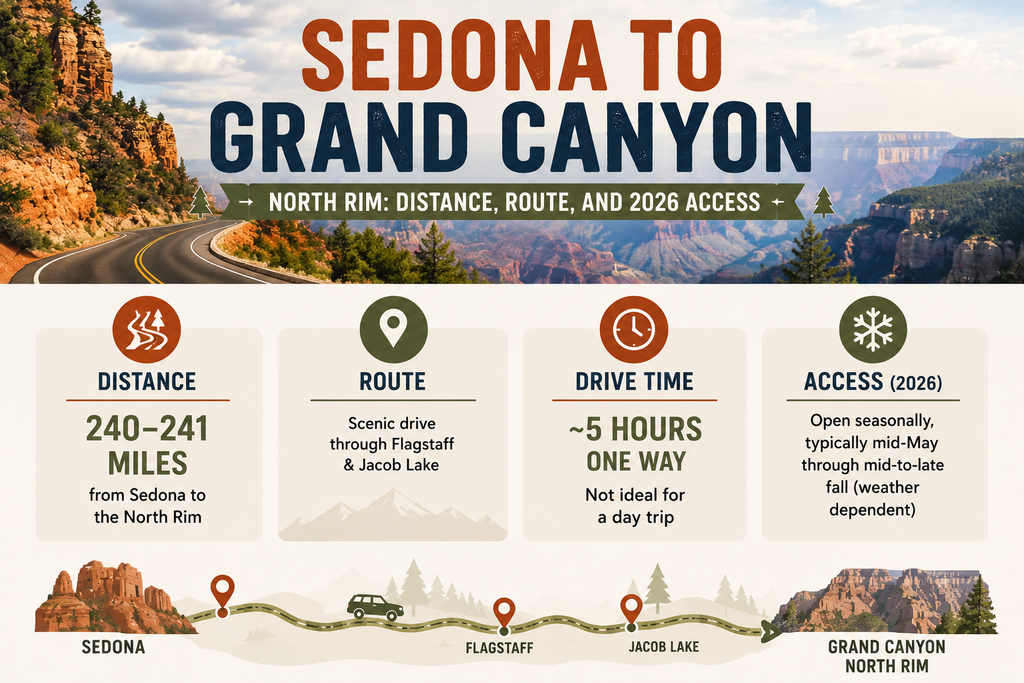
The Sedona to Grand Canyon North Rim trip is a different undertaking entirely, and it catches a lot of first-time planners off guard.
- Road distance from Sedona to the North Rim runs approximately 240 to 241 miles, roughly double the South Rim drive.
- Estimated drive time is close to 5 hours one way, making it a poor fit for a day trip from Sedona.
- The North Rim sits at a much higher, cooler elevation than the South Rim and is only accessible seasonally, typically mid-May through mid-to-late fall depending on weather.
A significant 2026 update: the Dragon Bravo Fire burned through the North Rim’s developed area in July 2025, destroying the historic Grand Canyon Lodge along with a number of other structures.
For the 2026 season, the National Park Service announced a tentative, phased reopening of select North Rim developed areas beginning May 15, though inner-canyon trails, including the North Kaibab Trail, remain closed pending extensive rockslide repairs and safety mitigation.
Overnight lodging at the historic lodge is not available this season since the building itself was lost, and services on the North Rim remain more limited than in a typical year.
Before You Book: If your trip depends on staying overnight at the Grand Canyon Lodge on the North Rim, know that it is currently unavailable due to the 2025 fire, with recovery still underway as of August 2026.
Confirm current operating status directly through the National Park Service before you build an itinerary around it, since conditions are actively evolving through the season.
Best Time of Day to Drive From Sedona to Grand Canyon
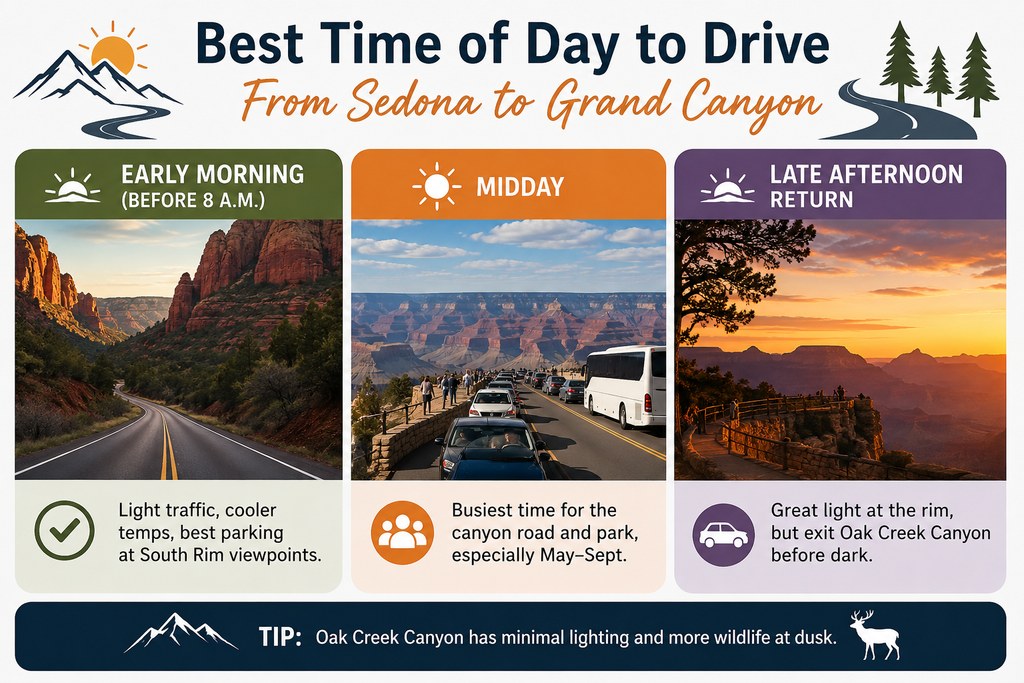
Timing this drive well makes a bigger difference than most people expect, and it is one of the most common planning questions our guests bring to us.
- Early morning (before 8 a.m.): Lightest traffic through Oak Creek Canyon, cooler temperatures, and the best odds of finding parking at popular South Rim viewpoints before tour buses arrive.
- Midday: Busiest window for both the canyon road and the park itself, especially May through September.
- Late afternoon return: Beautiful light for photos at the rim, but plan to be off Oak Creek Canyon before dark since the road has minimal lighting and wildlife activity increases at dusk.
What we usually suggest: leave Sedona as early as your group can manage, ideally by 7:30 a.m., and treat the return drive as the priority to finish before sunset rather than squeezing in one more overlook.
Driving Sedona to Grand Canyon in Winter
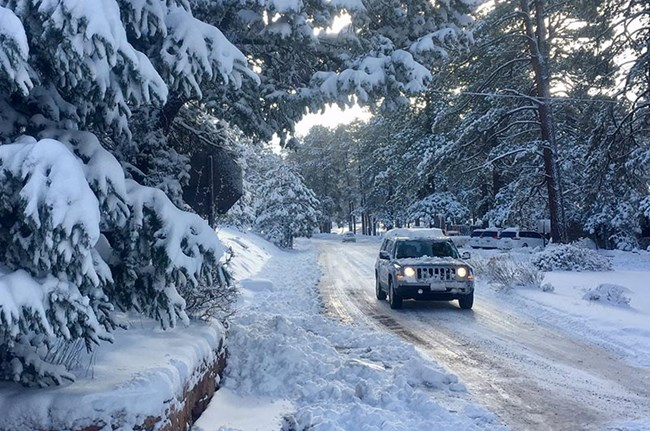
Winter changes this drive more than any other season, and it is a question we field constantly from guests booking a December or January stay.
- Sedona itself stays relatively mild in winter, with typical highs around 52 to 61°F and lows near 28 to 35°F, but conditions change fast as you climb toward Flagstaff and the canyon rim.
- Oak Creek Canyon and the higher elevations near Flagstaff regularly see snow and icy patches in winter, even when Sedona itself looks clear and dry.
- The South Rim sits at a high enough elevation that snow and ice on approach roads are common in winter months.
- We generally steer winter guests toward the I-17/I-40 route rather than Oak Creek Canyon, since interstate highways are prioritized for plowing and treatment ahead of the two-lane canyon road.
If you are driving north in winter, check Arizona Department of Transportation road conditions the morning of your trip rather than the night before, since mountain weather here can shift quickly.
Sedona to Grand Canyon RV Drive: What Larger Vehicles Should Know
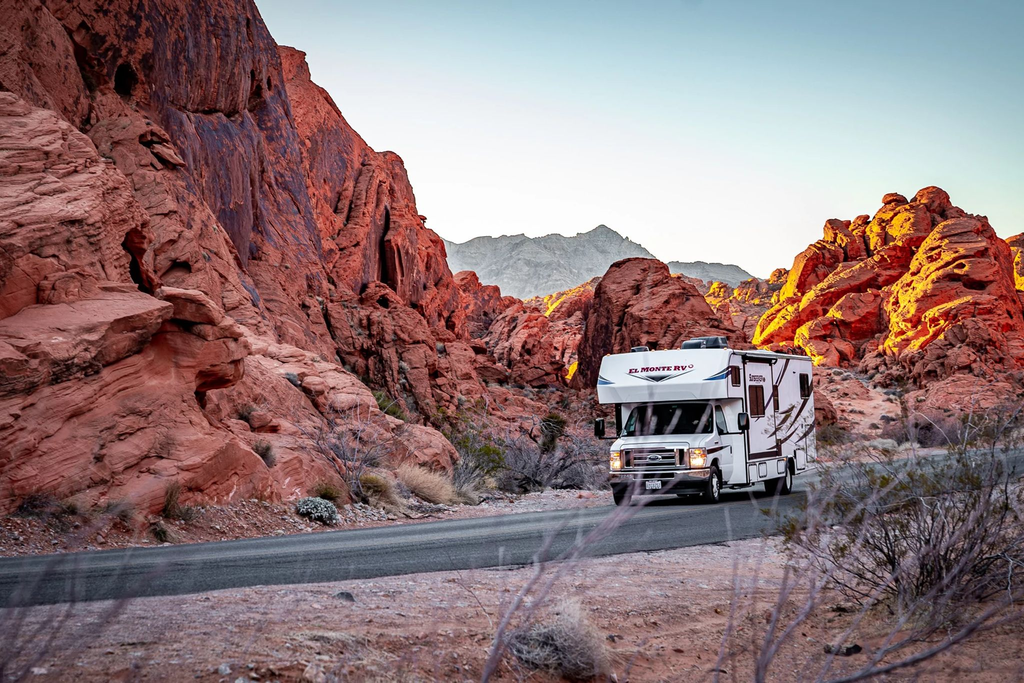
RVs, trailers, and larger rental vans need a different plan than a standard car, and this comes up often with guests bringing bigger vehicles.
- Oak Creek Canyon’s tight switchbacks and narrow shoulders make it a genuinely difficult route for RVs and anything towing a trailer.
- The I-17 South to I-40 West route is the more practical choice for a Sedona to Grand Canyon RV drive, since it avoids the canyon’s sharpest curves entirely.
- Fuel stops are more spread out on the interstate route, so top off in Flagstaff or Williams before continuing to the park.
- Parking at Grand Canyon Village has designated RV and oversized vehicle areas, but they fill early during peak season, so an early arrival matters even more for larger rigs.
Sedona to Grand Canyon Road Map: A Practical Planning Checklist
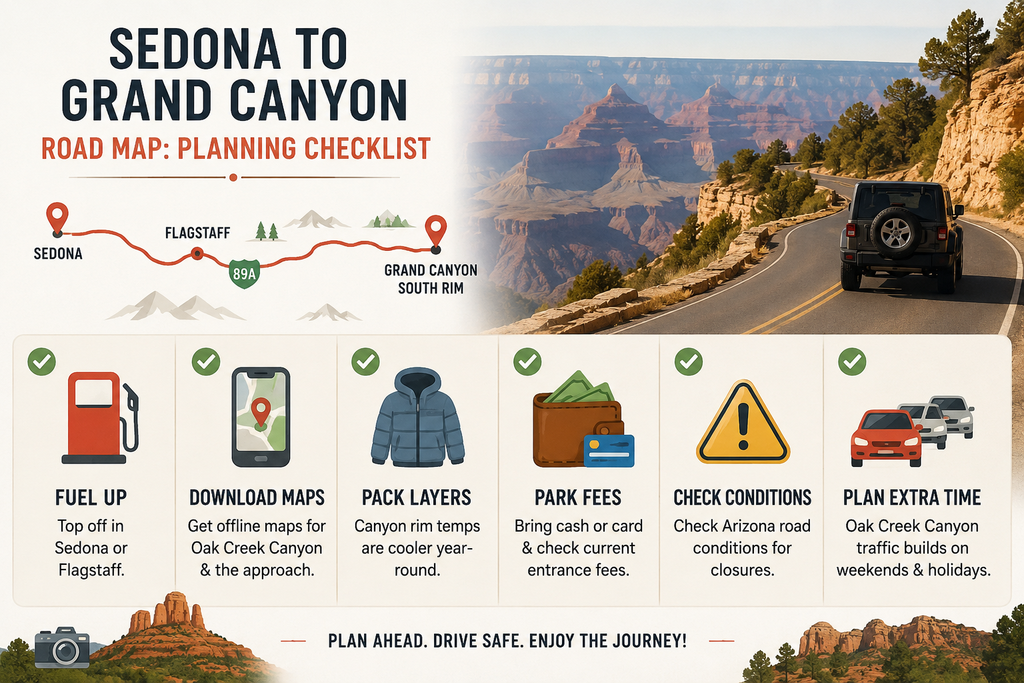
Before you leave Sedona, run through this quick checklist. It covers what we see guests forget most often.
- Fuel up in Sedona or Flagstaff, since gas stations thin out along the final stretch into the park.
- Download offline maps for the stretch through Oak Creek Canyon and the approach to the South Rim.
- Pack layers, since temperatures at the canyon rim run noticeably cooler than Sedona regardless of season.
- Pay entrance fees via credit/debit card or an America the Beautiful pass, as cash is no longer accepted at entrance gates ($35 per vehicle, $30 per motorcycle, $20 per individual on foot/bike).
- Check Arizona road conditions for any closures, especially in winter or during active wildfire season.
- Budget extra time for Oak Creek Canyon traffic, particularly on weekends and holidays.
Stay Wandery, Sedona: A Comfortable Base for Your Grand Canyon Trip
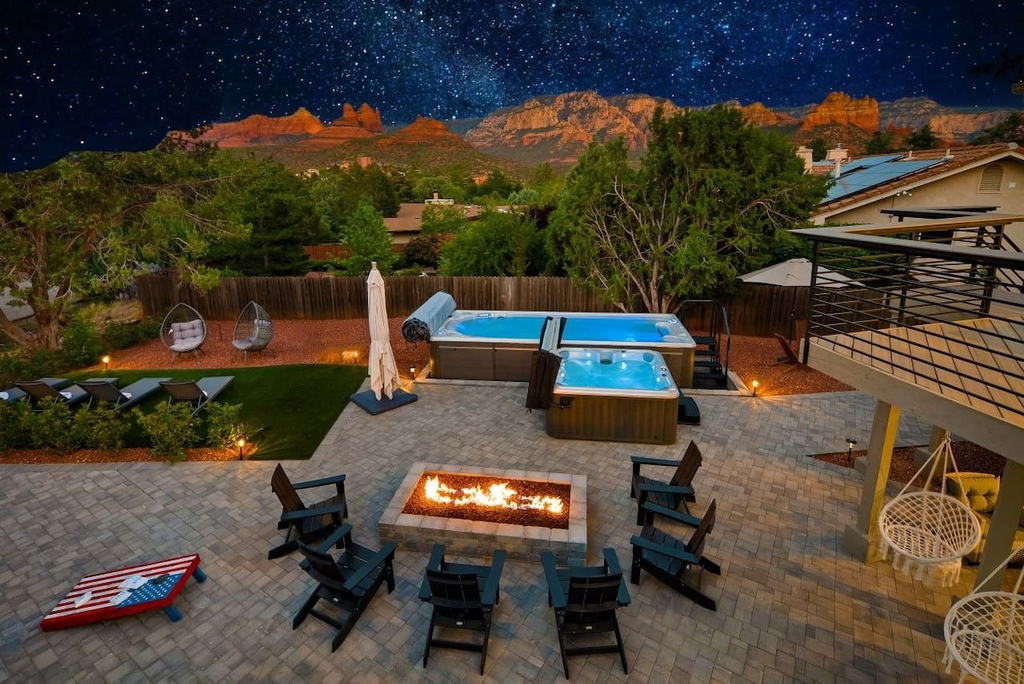
If you are planning to make this drive, where you sleep the night before and the night you return matters more than most guests expect.
We manage five vacation rental properties across Sedona, each suited to a slightly different kind of trip north.
- Uptown EPIC!: Sleeps up to 25 across two connected luxury homes with two kitchens, two game rooms, and two 20-foot heated pools and spas.
Best for large groups splitting into multiple vehicles for the Grand Canyon drive.
- Uptown Sparks!: Sleeps up to 13, with a 20-foot heated pool and hot tub, a fenced backyard, and a firetable.
Walkable to Uptown and steps from the start of Highway 89A.
- Starview Sedona!: Sleeps up to 12, with a 30-by-15-foot heated pool, an 8-person hot tub, an arcade room, and a pool table.
A relaxed spot to unwind after a long day of driving.
- SkyLine Sedona!: Sleeps up to 12, with a king bed in every bedroom, wall-to-wall red rock views, and an arcade room.
Central to town, which helps if you want an early, easy start north.
- Uptown Splash!: Sleeps up to 12, with a 20-foot heated pool and hot tub or swim spa, a putting green, and multiple entertainment areas.
Suited to families wanting space to spread out after a full day at the rim.

With a 4.4-star rating on Google, our five properties require a minimum 3-night stay, giving you plenty of time to pair a relaxing Sedona getaway with an easy Grand Canyon day trip in between.
Guests staying at our Uptown locations especially love getting a head start onto Highway 89A, letting them skip the extra drive through town and get right on the road.
The Road From Sedona to the Grand Canyon Is Calling
The Sedona to Grand Canyon drive is one of the more rewarding stretches of road in Arizona, and it does not have to be complicated.
Pick your route based on your vehicle and your tolerance for curves, leave earlier than feels necessary, and build in time for the stops that make this drive worth doing in the first place.
We talk through this exact trip with guests every week, and the ones who plan their route and departure time in advance consistently have the smoothest day.
If you are staying with us at Stay Wandery, our team is always happy to walk you through current road conditions and timing before you head north, whether you are booked at one of our Sedona properties right off 89A or one of our other homes across Sedona.
Whatever route you choose, give yourself the time this drive deserves rather than rushing it, and it will be one of the best days of your Arizona trip.
FAQs | Driving From Sedona to the Grand Canyon
1. How far is the Grand Canyon from Sedona by car?
The South Rim sits approximately 117 miles from Sedona depending on your route, with the scenic Oak Creek Canyon road being shorter in mileage and the I-17/I-40 route being longer but faster per mile. Most drivers should plan on roughly 2 hours and 15 minutes to 2 hours and 30 minutes of driving time without stops. Add extra time for photo stops, traffic, and any detours through Flagstaff.
2. What is the best route from Sedona to Grand Canyon South Rim?
For most first-time visitors, we recommend Highway 89A through Oak Creek Canyon for the scenery, connecting to US-180 and then AZ-64. If you are towing a trailer, driving an RV, or traveling in winter weather, the I-17 South to I-40 West route is the more practical and forgiving choice.
3. Is the drive from Sedona to the Grand Canyon dangerous?
No, not under normal conditions, though the curves in Oak Creek Canyon require an attentive driver. The road is paved and well maintained with guardrails at higher-risk turns, and the main challenges are traffic congestion and reduced visibility during monsoon storms or winter weather rather than the road design itself.
4. Can I visit the Grand Canyon from Sedona in one day?
Yes, a day trip is realistic if you leave by 7 to 8 a.m. and plan for roughly 4.5 to 5.5 hours of total driving. You will have time for a handful of key viewpoints, a rim walk, and photos, though a single day will not allow time for a below-the-rim hike.
5. How long does it take to drive from Sedona to the Grand Canyon?
Plan on 2 hours and 15 minutes to 2 hours and 30 minutes of pure driving time for the South Rim, and closer to 5 hours one way if you are headed to the more remote North Rim. Both estimates assume normal traffic and no extended stops along the way.
6. Should I take the scenic route or the highway route to the Grand Canyon?
Take Oak Creek Canyon if you want the classic Arizona scenery and you are comfortable with mountain curves, since it is genuinely one of the state’s most photographed drives. Take the I-17/I-40 interstate route if you prioritize predictability, are driving a larger vehicle, or are traveling in poor weather.
7. What towns or stops are between Sedona and the Grand Canyon?
Along the 89A route, expect Slide Rock State Park, Flagstaff, Sunset Crater Volcano National Monument, and Wupatki National Monument. If you route through US-89 toward the East Entrance instead, Cameron Trading Post becomes a worthwhile stop closer to the park itself.
8. Is there a train from Sedona to the Grand Canyon?
Not directly. The historic Grand Canyon Railway departs from Williams, Arizona, which is roughly an hour from Sedona by car, so you would need to drive to Williams first or book a packaged tour that includes hotel pickup in Sedona along with the train ride.
9. How far is the Grand Canyon North Rim from Sedona compared to the South Rim?
The North Rim is roughly double the distance of the South Rim from Sedona, at approximately 240 miles and close to 5 hours of driving one way. The North Rim is also only open seasonally and, as of the 2026 season, is operating with limited services following a 2025 wildfire that destroyed the historic lodge.
10. What time should I leave Sedona to avoid crowds at the Grand Canyon?
Leaving Sedona by 7 to 7:30 a.m. gives you the best chance of light traffic through Oak Creek Canyon and available parking at the South Rim before the busiest midday window. This timing matters most from late spring through early fall, when both the canyon road and the park see their heaviest visitor numbers.
Sources Consulted:
- National Park Service (nps.gov/grca) for entrance fees, North Rim status, and Desert View Entrance information
- U.S. Forest Service (fs.usda.gov) for Coconino National Forest closure orders and Oak Creek Canyon recreation site status
- Arizona Department of Transportation for SR 89A route designation and road data
- Grand Canyon Railway official booking information for train schedules and pricing
- Our team’s operational experience hosting guests at Stay Wandery, Sedona